
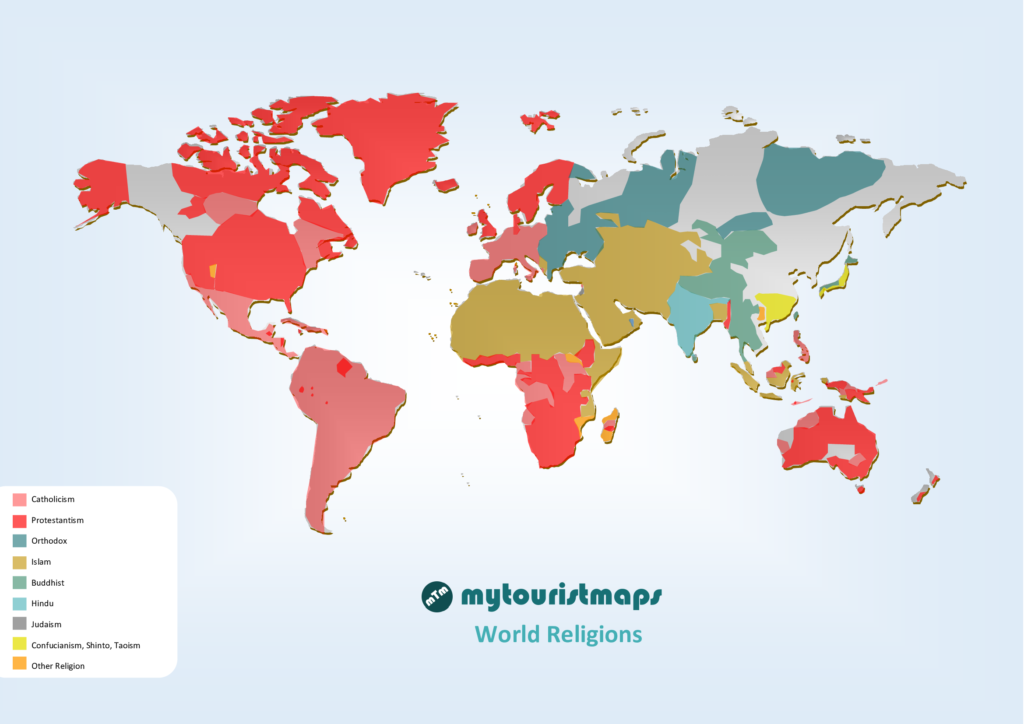
Learning about people’s culture is essential to truly travel.
Catholicism
Catholicism is the largest branch of Christianity, centred on the authority of the Pope in Vatican City and the traditions of the Roman Catholic Church. Catholics believe in one God expressed as the Holy Trinity: Father, Son, and Holy Spirit. Jesus Christ is considered the Son of God and the saviour of humanity. The Bible, along with Church tradition and teachings of the clergy, guides religious life. The seven sacraments—such as baptism, communion, and confession—are central to worship. Catholicism places strong emphasis on charity, community, and moral teachings. It is especially widespread in Europe, Latin America, the Philippines, and parts of Africa.
Protestantism
Protestantism is a major branch of Christianity that emerged during the 16th-century Reformation, challenging the authority of the Catholic Church. Reformers such as Martin Luther argued that salvation comes through faith alone rather than through church institutions or rituals. Protestants emphasise the Bible as the primary authority for religious belief and practice. As a result, Protestantism includes many different denominations, such as Lutheran, Anglican, Baptist, and Methodist churches. Worship tends to be simpler than in Catholicism, focusing on scripture, preaching, and prayer. Protestant communities are widespread in northern Europe, North America, parts of Africa, and Oceania.
Orthodox Christianity
Orthodox Christianity is one of the oldest forms of Christianity, tracing its traditions to the early Christian Church of the Eastern Roman (Byzantine) Empire. It separated from the Roman Catholic Church in the Great Schism of 1054. Orthodox Christians share many beliefs with Catholics, including the Trinity and the divinity of Jesus Christ, but they do not recognise the Pope’s authority. Instead, the church is organised into independent national patriarchates such as the Greek and Russian Orthodox Churches. Worship is highly traditional, featuring ancient liturgies, icons, and chants. Orthodox Christianity is strongest in Eastern Europe, the Balkans, Greece, Russia, and parts of the Middle East.
Judaism
Judaism is one of the world’s oldest monotheistic religions, originating in the Middle East more than 3,000 years ago. Jews believe in one God who revealed divine laws and teachings to the prophet Moses. The central sacred text is the Torah, which forms part of the Hebrew Bible. Jewish religious life focuses on following commandments, ethical living, and maintaining a strong sense of community and cultural identity. Important traditions include observing the Sabbath, dietary laws known as kosher, and major festivals such as Passover and Yom Kippur. Today, Jewish communities exist worldwide, with the largest populations in Israel and the United States.
Buddhism
Buddhism began in the 6th century BCE with Siddhartha Gautama, known as the Buddha, in what is now Nepal and northern India. Rather than focusing on a creator god, Buddhism teaches a path to overcome suffering and achieve enlightenment. Central ideas include the Four Noble Truths, which explain the nature of suffering, and the Eightfold Path, a guide to ethical living, mental discipline, and wisdom. Buddhists aim to free themselves from the cycle of rebirth known as samsara by attaining nirvana. There are several traditions, including Theravada, Mahayana, and Vajrayana. Buddhism is especially common in East Asia and Southeast Asia.
Islam
Islam is a monotheistic religion founded in the 7th century in the Arabian Peninsula by the Prophet Muhammad. Muslims believe in one God, called Allah, and consider the Quran the final and complete revelation from God. The core practices of Islam are the Five Pillars: declaring faith, praying five times daily, giving charity, fasting during the month of Ramadan, and making a pilgrimage to Mecca if possible. Islam emphasises social justice, charity, and obedience to God’s guidance. Two major branches exist: Sunni and Shia. Islam is the second-largest religion in the world, widespread across the Middle East, Africa, and Asia.
Hinduism
Hinduism is one of the world’s oldest and most diverse religions, originating in the Indian subcontinent thousands of years ago. Rather than a single founder or unified doctrine, it includes many philosophical traditions, practices, and deities. Many Hindus believe in a universal spiritual reality called Brahman, with gods such as Vishnu, Shiva, and Devi representing different aspects of the divine. Key concepts include karma (actions and consequences), dharma (duty and moral order), and samsara (the cycle of rebirth). The ultimate goal is moksha, liberation from this cycle. Sacred texts include the Vedas, Upanishads, and the Bhagavad Gita.
Confucianism
Confucianism is a philosophical and ethical tradition based on the teachings of Confucius, a Chinese thinker who lived in the 6th–5th centuries BCE. Rather than focusing primarily on worship or gods, it emphasises moral behaviour, social harmony, and respect within human relationships. Key principles include filial piety (respect for parents and ancestors), righteousness, loyalty, and proper conduct. Confucianism strongly influenced the Chinese government, education, and family structure for centuries. Its teachings are preserved in texts such as the Analects. Today, it continues to shape cultural values in China, Korea, Vietnam, and other parts of East Asia.
Shinto
Shinto is the traditional religion of Japan and is deeply connected to the country’s culture and natural environment. It centres on the belief in kami, spiritual forces or sacred presences that inhabit natural features such as mountains, rivers, trees, and ancestral spirits. Shinto practices focus on rituals, purification, and respect for nature rather than formal doctrines or scriptures. Shrines dedicated to specific kami are places where people offer prayers and participate in festivals. Shinto often coexists peacefully with Buddhism in Japan, with many people following elements of both traditions in daily life and during important life events.
Taoism
Taoism, also spelt Daoism, is a Chinese philosophical and religious tradition that emerged around the 4th century BCE. It is based on the concept of the Tao, meaning “the Way,” the natural order that flows through the universe. Taoism teaches that harmony and balance are achieved by living simply and following the natural rhythm of life rather than resisting it. The classic text of Taoism is the Tao Te Ching, traditionally attributed to the sage Laozi. Important ideas include balance between opposites (yin and yang), humility, and non-action or effortless action known as wu wei. Taoism has influenced Chinese culture, medicine, and spirituality for centuries.