
“The sea is dangerous and its storms terrible, but these obstacles have never been sufficient reason to remain ashore… Unlike the mediocre, intrepid spirits seek victory over those things that seem impossible… It is with an iron will that they embark on the most daring of all endeavours… to meet the shadowy future without fear and conquer the unknown.”
― Ferdinand Magellan
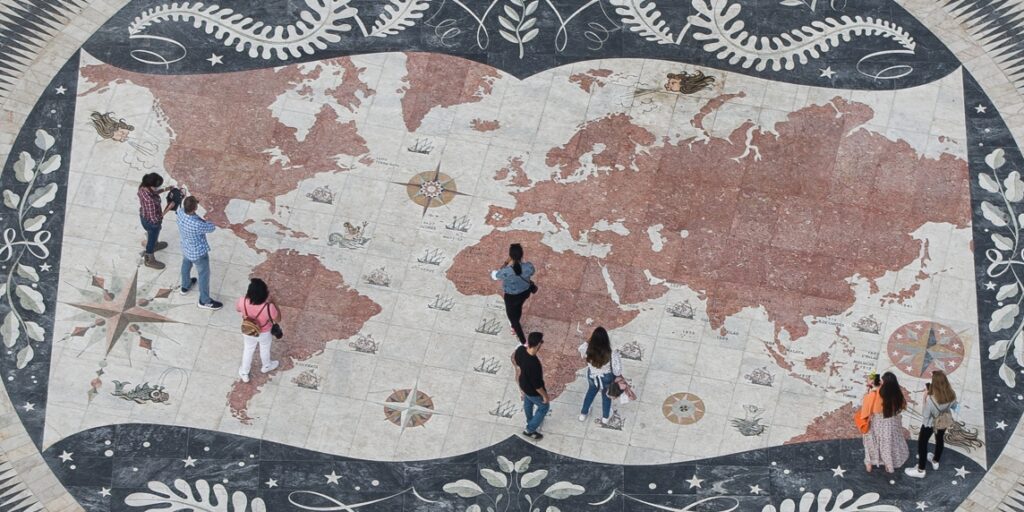
Gifted by the South African Government and designed by the architect Cristino Da Silva, the square at Padrao dos Descobrimentos in Belem, Lisbon, represents the map of Portuguese maritime routes during the Age of Discovery.
Ferdinand Magellan – Juan Sebastiàn Elkano
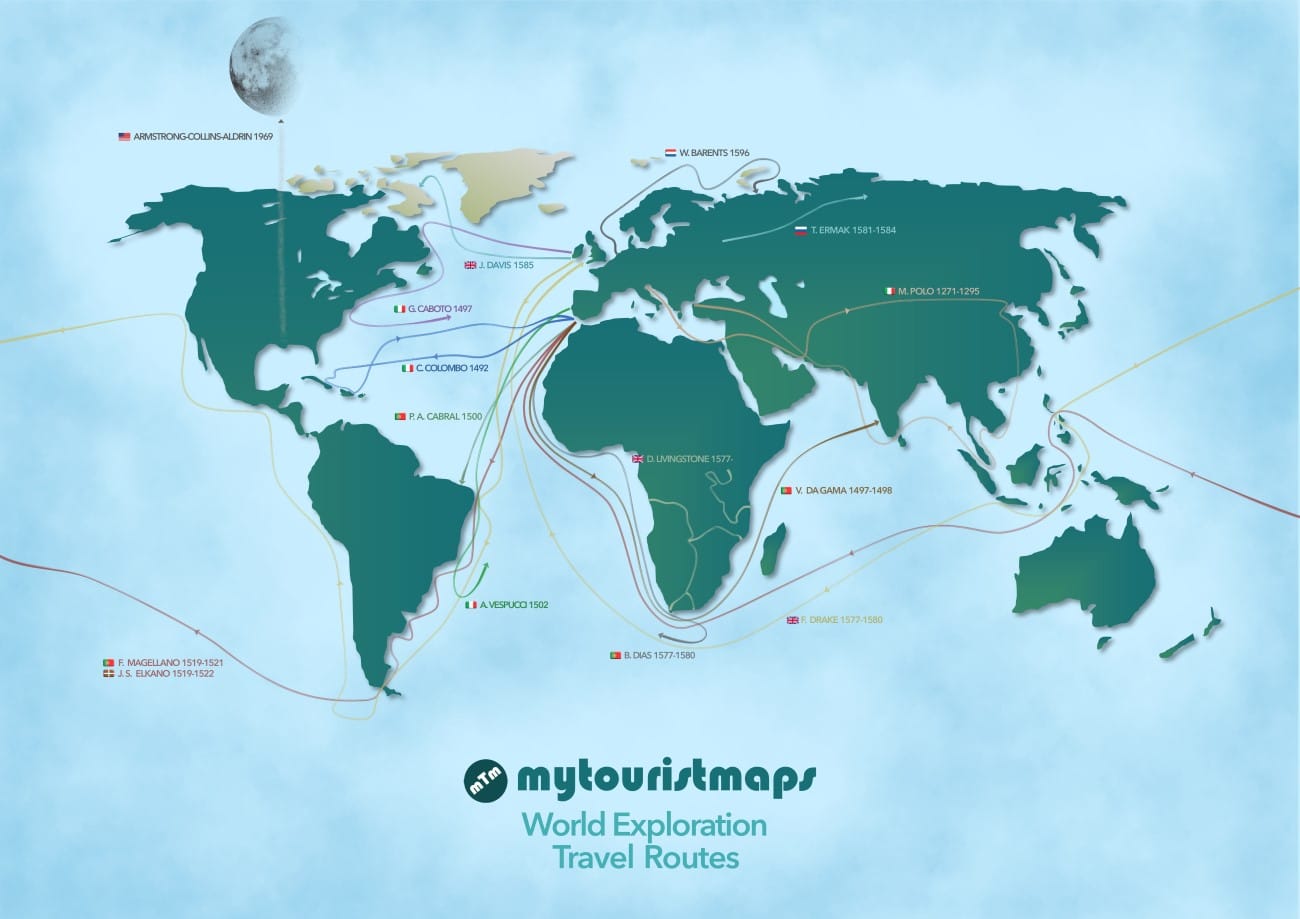
In 1519, Ferdinand Magellan led an expedition from Spain that would become the first to circumnavigate the Earth. Although Magellan was killed in the Philippines, his fleet crossed the Atlantic, navigated the treacherous strait at South America’s tip, and entered the vast Pacific Ocean, proving that the world’s oceans were connected and far larger than Europeans had imagined. While Magellan is widely recognised to be the first explorer to have completed the circumnavigation, the reality is another: since he was killed, the Basque Juan Sebastiàn Elkano took over the expedition and completed it, becoming the first commander to circumnavigate the globe along with the 17 survivors (out of the initial 234 crewmen).
David Livingstone
During the 19th century, Scottish explorer David Livingstone travelled thousands of kilometres across southern and central Africa. Following major rivers such as the Zambezi and discovering the spectacular Victoria Falls, his expeditions revealed vast regions previously unknown to Europeans and helped map the interior of the African continent.
Marco Polo
In the 13th century, Venetian merchant Marco Polo travelled from Europe to China along the Silk Road. After years at the court of Kublai Khan, he returned to Venice describing rich cities, exotic cultures and immense trade networks across Asia. His stories inspired generations of explorers searching for new routes to the East.
Vasco da Gama
Portuguese navigator Vasco da Gama made history in 1498 by reaching India by sea. Sailing around the Cape of Good Hope and across the Indian Ocean, his voyage established the first direct maritime route between Europe and Asia, opening centuries of global trade and transforming the balance of power on the world’s oceans.
Francis Drake
Between 1577 and 1580, English privateer Francis Drake completed the second circumnavigation of the globe. Sailing through the Strait of Magellan and across the Pacific, Drake raided Spanish ports and ships throughout the Americas, returning to England with immense treasure and becoming a national hero.
Willem Barents
Dutch explorer Willem Barentsz searched for a Northeast Passage to Asia through the Arctic Ocean in the late 1500s. His expeditions discovered Spitsbergen and mapped parts of the Barents Sea. Trapped by ice during his final voyage, Barents and his crew survived a harsh Arctic winter in one of the earliest polar exploration stories.
Bartolomeu Dias
In 1488, Portuguese navigator Bartolomeu Dias became the first European to round the southern tip of Africa. Battling powerful Atlantic storms, he proved that a sea passage to the Indian Ocean existed. His discovery of the Cape of Good Hope paved the way for later voyages to India and the East.
Christopher Columbus
In 1492, Italian navigator Christopher Columbus sailed west from Spain hoping to reach Asia. Instead, he encountered the Caribbean islands, opening sustained contact between Europe and the Americas. His voyages dramatically reshaped world history, trade routes and cultural exchange across the Atlantic.
Pedro Álvares Cabral
Portuguese commander Pedro Álvares Cabral was sailing to India in 1500 when his fleet drifted west across the Atlantic and reached the coast of Brazil. Claiming the land for Portugal, Cabral continued around Africa to India, linking South America to the expanding Portuguese trading network.
John Cabot
Sailing under the English flag in 1497, John Cabot crossed the North Atlantic and reached the coasts of Newfoundland and possibly Labrador. His voyage helped establish England’s earliest claims in North America and opened rich fishing grounds that attracted European sailors for centuries.
Amerigo Vespucci
Florentine navigator Amerigo Vespucci explored the Atlantic coasts of South America around 1500. Studying the immense rivers and coastlines, he concluded that these lands were not Asia but an entirely new continent. In his honour, European cartographers later named the newly mapped lands “America”.
Yermak Timofeyevich
Cossack leader Yermak Timofeyevich led the first Russian expedition across the Ural Mountains in the 1580s. His campaign defeated the Siberian Khanate and opened the vast forests and rivers of Siberia to Russian exploration, starting centuries of eastward expansion across northern Asia.
Apollo 11 Moon Mission
In July 1969, the spacecraft of Apollo 11 carried humans beyond Earth for the first time. Astronauts Neil Armstrong and Buzz Aldrin landed on the Moon while Michael Collins orbited above, marking one of humanity’s greatest exploration achievements.