
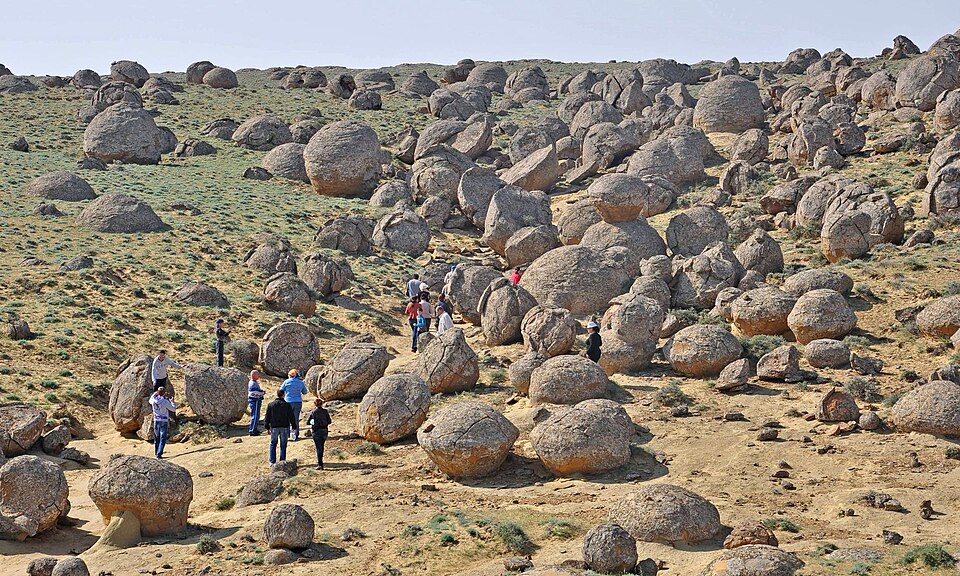
In the remote Mangystau Region of western Kazakhstan, the landscape changes from ordinary desert into something that seems almost impossible. Across a vast stretch of open steppe, hundreds of strangely rounded rocks lie scattered across the ground, ranging from small stones to enormous spheres several metres in diameter.
This is Torysh Valley, better known as the Valley of Balls, one of the most unusual geological landscapes in Kazakhstan. The formations are so remarkably round that, at first sight, they can look artificial. Yet they are entirely natural, created by geological processes that took place millions of years ago.
The surrounding landscape makes the experience even more remarkable. There are no forests, towns or developed tourist facilities here. Instead, the stone spheres sit among the dry plains and low hills of Mangystau, creating an extraordinary scene that feels more like another planet than western Kazakhstan.
The Valley of Balls
The most striking feature of Torysh Valley is the enormous collection of spherical rock formations scattered across the desert.
The stones vary considerably in size. Many are relatively small, while some reach around four metres in diameter. They are not all perfectly spherical either. Some are oval, irregular or partly eroded, while others have broken open to reveal their internal layers.
The formations often occur in groups, with dozens of spheres visible across the same stretch of terrain. Walking between them gives a much better impression of their scale than photographs can convey.
Their unusual appearance has made Torysh one of the signature natural attractions of Mangystau. The official tourism material of Kazakhstan describes the Valley of Balls as one of the region’s most mysterious landscapes, while modern geological descriptions generally classify the formations as concretions.

Ancient Geological Formations
The stone spheres are generally interpreted as concretions, geological structures formed when mineral material accumulates around a central nucleus within sedimentary deposits.
Over very long periods, minerals can cement material around a small central particle, producing a harder mass inside softer surrounding sediments. Erosion then gradually removes the softer material, leaving the more resistant concretion exposed.
The precise geological history of the Torysh formations is more complicated, and different sources have proposed different ages and mechanisms. Some accounts associate the formations with ancient marine sediments and the former Tethys Ocean, while other hypotheses have involved tectonic activity.
This uncertainty is part of what makes Torysh so interesting. The formations are clearly natural geological structures, but their precise origin and development remain a subject of scientific discussion.
The broader Mangystau landscape has a remarkable geological history. Much of the region was once associated with ancient marine environments, and fossils from former marine life can be found in parts of the area. Today, erosion has exposed the ancient sediments as deserts, cliffs, plateaus and unusual rock formations.
The Landscape of Mangystau
Torysh is not an isolated curiosity surrounded by an otherwise ordinary landscape. It belongs to one of the most geologically fascinating regions of Central Asia.
Mangystau occupies the far west of Kazakhstan, beside the Caspian Sea. The region is characterised by vast deserts, chalk cliffs, canyons, isolated mountains and enormous open spaces.
Among its best-known landscapes are Bozzhyra, with its spectacular white cliffs and rock towers, Sherkala Mountain, the castle-like formations of Airakty, and the underground mosques scattered across the region.
Torysh provides a completely different experience. Instead of dramatic cliffs rising hundreds of metres above the desert, the attraction is spread across the ground itself. The stone spheres are surrounded by a seemingly endless steppe, making the landscape feel unusually spacious and remote.
Local Legends
The strange appearance of the formations has naturally inspired legends.
One traditional story tells of an invading army that entered the region. According to the legend, the local people prayed for protection, after which a powerful storm arrived. Lightning struck the invading forces and turned them to stone, leaving the countless stone figures that can still be seen across the valley.
The story is folklore rather than a scientific explanation, but it reflects how extraordinary geological formations have inspired stories throughout human history.
The nickname Valley of Balls is therefore much more straightforward than the legends surrounding the site. It simply describes exactly what visitors encounter: a vast valley covered with rounded stone formations.
Exploring the Stone Spheres
There is no single viewpoint that defines Torysh Valley. The best way to experience it is to get out of the vehicle and walk among the formations.
Some of the most interesting spheres are those that have cracked apart. Their broken surfaces reveal concentric layers and textures that are not visible from the outside.
The different stages of erosion can also be seen throughout the valley. Some formations remain relatively intact, while others are heavily weathered and gradually disappearing into the surrounding sediment.
The landscape is particularly impressive from a distance, where individual spheres appear as isolated dots across the desert. From closer up, their texture, cracks and unusual shapes become the main attraction.
Photography is another major reason to visit. The low sun around sunrise and sunset creates long shadows around the formations and emphasises their three-dimensional shapes. During the middle of the day, the strong overhead light can make the landscape appear flatter.
Getting to Torysh Valley
Torysh Valley is located roughly 105–110 km northeast of Aktau, making Aktau the natural base for exploring the area. It is also close to the village of Shetpe, although exact distances vary depending on which part of the valley is being visited.
From Aktau, the journey begins on roads leading towards the northern part of the Mangystau region before continuing onto smaller and often unpaved tracks.
The official Kazakhstan tourism portal describes two approaches from Aktau. One route leaves the main road after approximately 95 km and continues east towards Torysh, while another continues farther before turning towards the valley. Road conditions can change considerably after rain, when normally manageable tracks can become difficult.
Because the valley is remote and road signage is limited, a 4×4 vehicle with an experienced local driver is the safest and most practical option. Many visitors experience Torysh as part of a wider Mangystau tour rather than attempting to reach it independently.
The journey is commonly combined with Kokkala, Sherkala Mountain and Airakty Valley, creating a full day of geological and desert landscapes from Aktau.
Best Time to Visit
The best time to visit Torysh Valley is during spring and autumn, particularly April to May and September to October.
These months offer much more comfortable conditions for exploring the exposed desert landscape. Summer can be extremely hot in Mangystau, while there is virtually no shade around the stone formations.
Spring can also bring a little more vegetation to the normally barren landscape, adding subtle colour around the rocks. Autumn provides cooler temperatures and excellent light for photography.
Whatever season you choose, early morning and late afternoon are the most atmospheric times of day. The lower angle of the sun brings out the textures of the spheres and creates stronger shadows across the desert.
Practical Information
There are no conventional tourist facilities at Torysh Valley. Visitors should not expect restaurants, shops, toilets or a visitor centre.
Bring sufficient water and food before leaving Aktau or another settlement. Sun protection, a hat, sunglasses and sturdy footwear are also important, particularly if you plan to walk away from the vehicle.
Navigation should be planned in advance because the area is remote and roads can be difficult to identify. Mobile coverage should not be relied upon throughout the wider Mangystau wilderness.
The official tourism information also warns that road conditions can deteriorate significantly after rain. For this reason, travelling with a local driver who knows the tracks is preferable to relying on a standard rental car.
A Gateway to Mangystau
One of the greatest advantages of visiting Torysh Valley is that it can easily be incorporated into a larger journey through Mangystau.
A typical route can combine the Valley of Balls with Sherkala Mountain, the colourful geological formations of Kokkala, Airakty Valley and eventually the spectacular Bozzhyra landscapes.
This makes Torysh particularly valuable for travellers interested in geology and unusual natural scenery. While Bozzhyra provides enormous cliffs and dramatic viewpoints, Torysh offers a much more intimate encounter with the geology of the region.
Together, these places demonstrate why western Kazakhstan has become one of the most interesting destinations for travellers looking beyond the country’s better-known cities and mountain landscapes.
For visitors willing to travel deep into the desert, Torysh Valley offers something genuinely unusual: an enormous natural collection of stone spheres scattered across one of the most remote and spectacular landscapes of Kazakhstan.