
Seven cone-roofed houses sit on a ridge eleven hundred meters up in the Flores highlands, wrapped in cloud through most of the year and reachable only by a footpath through the forest. This is Wae Rebo, a village that has held onto one of the last complete examples of a building style once common across the island, along with a way of life that hasn’t bent much for the visitors who now make the climb to see it.
A Village Built in Cones
The houses are called mbaru niang, and there is nothing else in Indonesia quite like them. Bamboo and rattan frames rise into a cone, wrapped almost to the ground in a thick skirt of lontar palm thatch, so that from a distance a house looks less like a building than a haystack with a door. Inside, each one splits into five levels, and the split is functional rather than decorative: the ground floor, lutur, is where families sleep and eat; the second, lobo, holds everyday food and goods; the third, lentar, is set aside for next season’s seed; the fourth, lempa rae, keeps an emergency store against drought; and the fifth and smallest, hekang kode, is reserved for offerings to the ancestors. No two houses are quite the same size — the Niang Gendang, the ceremonial house at the center of the circle, shelters eight families on its own, while the other six each hold about six.
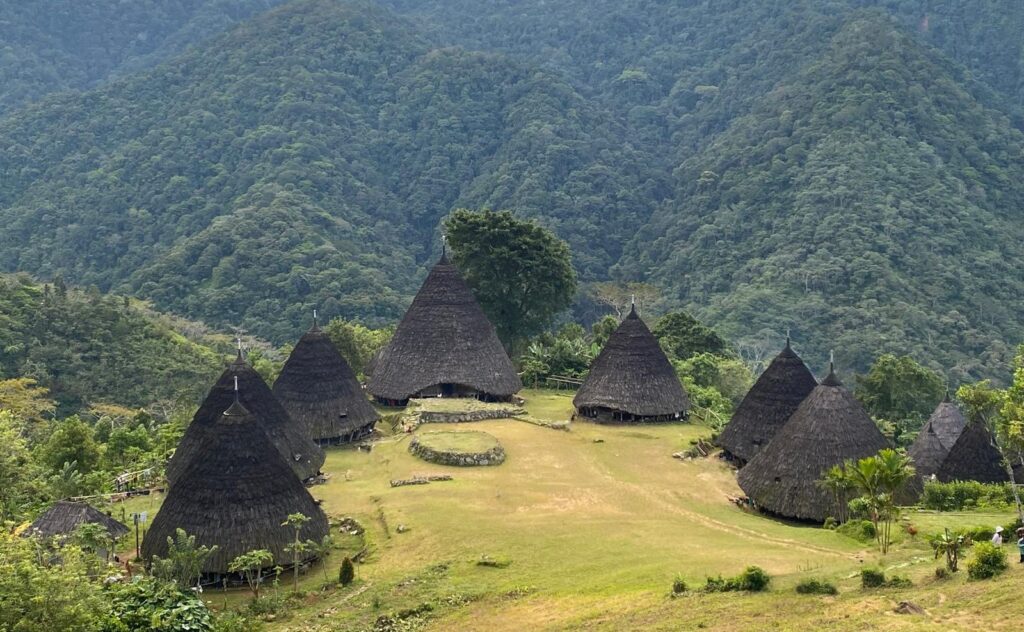
The roofs get rethatched every so often, but the frames are original enough that Wae Rebo is generally regarded as the last village on Flores where this architecture survives intact, rather than as a single restored example among modern buildings. That distinction earned it a Top Award of Excellence from UNESCO in 2012, recognizing the community for rebuilding the houses without losing the methods that made them work in the first place.
How the Village Came to Be
Local accounts trace the village to a man named Empu Maro, said to have led his family away from the Minangkabau region of Sumatra after a vision pointed him toward the mountains of Flores. The settlement he founded was occupied for nineteen generations, abandoned at some point, then rebuilt and reoccupied in 1920 — the houses standing today are essentially that reconstruction, kept up ever since by descendants of the same clan. Roughly forty-four families trace their line back to Empu Maro, though only a fraction live in Wae Rebo full time; many keep houses down in the valley and rotate up to the village for the growing season or for ceremonies. Most residents are Catholic, but the older customs run alongside that faith rather than under it — the Niang Gendang still stores the drums and gongs used in ritual, and a welcome ceremony is performed for every visitor who stays the night. Below the ridge, terraced plots supply cassava and maize for the village itself, with coffee, vanilla and cinnamon grown as cash crops and carried down the mountain to sell.
Best Time to Visit
The dry season, roughly May through October, is the easier window: the trail firms up, the clouds lift more often, and the view back down the valley actually clears. Outside those months, rain turns sections of the path to mud and can close in the mountain for days at a time. Even in the dry months, nights at 1,200 meters get cold enough that a warm layer matters more than most people pack for; days can be humid on the walk up and sharply cooler after dark. Weekday visits are noticeably quieter than weekends, when group tours from Labuan Bajo tend to cluster.
Getting to Wae Rebo
There’s no direct route. Getting to Wae Rebo means flying into Komodo International Airport at Labuan Bajo, then driving four to five hours over a rough mountain road to Denge, the last village with vehicle access. From there it’s a walk of about ten kilometers round trip, climbing roughly 750 meters through forest on a path that’s cobbled in places and takes most visitors somewhere between three and five hours each way. There’s no booking system — arrivals are handled first-come, first-served by the village cooperative, so an early start from Denge is worth more than a reservation. An overnight stay with meals and the welcome ritual runs around 325,000 rupiah per person; a day visit without staying costs less, and a guide can be hired on-site for those who want one, though the trail itself is hard to lose. Electricity runs on a generator for a few hours each evening, there’s no mobile signal at all, and the sleeping arrangement is a shared mat on the floor of one of the houses — which, after the climb, tends to be exactly enough.
What makes the ten kilometers worth it isn’t really the view, though the ridge has one. It’s that the houses, the ceremonies and the farming below them are still running as one working system rather than staged for the people who come to look, a rarer thing on Flores, and in Indonesia generally, than it used to be. Travelers curious about the country’s other volcanic and cultural landmarks can also see Indonesia’s spectacular Gunung Bromo, or, if fascinated by, letàs say “unconventional” places, browse the wider list of unusual places around the world.