
High above the valleys of central Nepal, enormous honeycombs hang from vertical cliffs where the rock seems to be impossible to reach. Twice a year, experienced honey hunters approach these colonies using handmade ladders, bamboo poles, ropes and their remarkable knowledge of the bees.
This is honey hunting in Nepal, one of the most extraordinary traditional practices in the Himalayas.
For centuries, the Gurung communities of Nepal have harvested wild honey from cliffs where the Himalayan giant honey bee (Apis laboriosa) builds its enormous exposed nests. The harvest is not simply a way of collecting honey. It is a seasonal event involving religious rituals, teamwork, inherited knowledge and a great dose of courage.
Today, honey hunting is also attracting travellers who want to witness one of Nepal’s most unusual cultural traditions. However, this is very different from a conventional tourist attraction. Visitors generally watch from a safe distance while experienced local hunters carry out the dangerous work.

The Himalayan Giant Honey Bee
The story begins with an extraordinary insect.
The Himalayan giant honey bee, Apis laboriosa, is one of the largest honey bees in the world. Unlike domesticated bees, these wild bees cannot simply be kept in conventional hives. They construct large, exposed honeycombs on steep rock faces, often high above forested valleys.
The location of the colonies is one of the reasons honey hunting is so difficult. The bees choose cliffs that provide protection from predators and human access, leaving the honeycombs suspended in places where reaching them requires exceptional climbing skills.
The bees are also important to the Himalayan ecosystem. By moving between flowering plants while collecting nectar and pollen, they contribute to pollination across the mountain environment.
For the Gurung honey hunters, generations of observation have produced an intimate understanding of the bees. Hunters know the cliffs, recognise suitable colonies and understand when conditions are right for harvesting.
A Traditional Honey Hunt
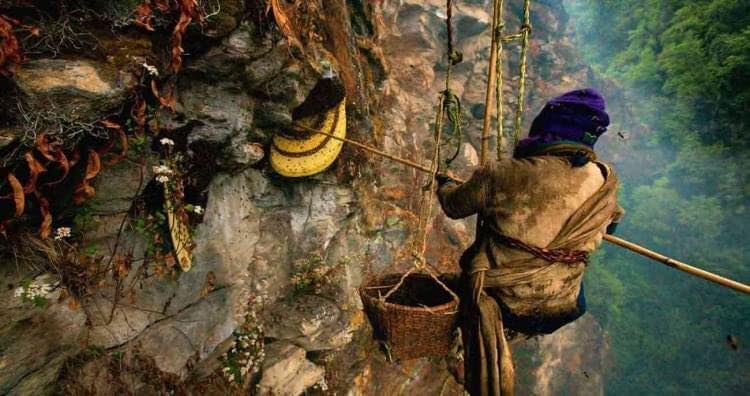
The hunters arrive beneath a cliff carrying the equipment needed for the harvest. A long handmade ladder is secured from the top and suspended down the rock face. Smoke is then used to drive the bees away from the honeycombs and make the colony easier to approach.
The hunter descends the ladder towards the colony while members of the team remain above and below to provide support.
From this precarious position, the hunter uses long bamboo poles and traditional tools to reach the honeycomb. Sections of the comb are cut away and collected in baskets before being lowered back to the ground.
The hunter may be hanging tens of metres above the valley floor, surrounded by thousands of bees, with nothing resembling the safety equipment that would normally be expected for such a climb.
This is why honey hunting is not an activity for inexperienced visitors. The hunters who perform it have developed their skills over many years, and the technique is traditionally passed from one generation to another.
Honey hunting also has an important spiritual and communal side. Among Gurung communities, the harvest traditionally involves rituals and offerings intended to seek protection and a successful hunt. Food is prepared, equipment is transported to the site and different members of the community take on different responsibilities.
The exact customs vary between villages, but the important point is that the hunt is not simply an individual climbing expedition. It can be a major community event connecting people, tradition and the natural environment.
The Famous Mad Honey
Nepal’s cliff honey is sometimes associated with “mad honey”, a name that has attracted considerable attention from travellers and the international media.
The term refers to honey that contains grayanotoxins, naturally occurring compounds that can be present when bees collect nectar from certain plants, including some species of rhododendron.
Consuming sufficient quantities can cause dizziness, nausea, vomiting, weakness, sweating and changes in blood pressure or heart rate. The concentration of grayanotoxins can also vary, so “mad honey” should not be treated as an exotic recreational product.
The fascination with mad honey has sometimes overshadowed the much more interesting story behind it: the relationship between the bees, the Himalayan environment and the communities that have harvested wild honey for generations.
When and Where to See Honey Hunting
Honey hunting traditionally takes place during seasonal periods when the colonies contain sufficient honey. In many parts of Nepal, the main opportunities are associated with spring and autumn, although the exact timing depends on the location, weather, flowering conditions and local decisions.
One of the best-known areas is the Gandaki region of central Nepal, particularly parts of Kaski and Lamjung. Villages such as Bhujung, Ghanpokhara, Taghring, Mipra, Taapgaun, Chyamche, Ghermu, Dudhpokhari and Ghalegaun have been associated with traditional honey hunting.
Most visitors begin from Kathmandu or Pokhara. Pokhara is particularly convenient for exploring honey-hunting areas in the Gandaki region. From there, the journey usually continues by road towards rural communities, followed by hiking to the cliffs where the colonies are located.
The final approach can be considerably more demanding than the road journey suggests. Rural roads can be rough, while trails to the cliffs may involve steep terrain.
Because the harvest is controlled by local communities and depends on the natural cycle of the bees, arranging a visit through a local guide or community-based tourism operator is strongly recommended. A guide can establish whether a hunt is actually taking place and explain where visitors can safely observe it.
There is no guarantee of seeing an active harvest simply because you visit during the right season. Weather, bee populations and local decisions can all affect the timing.
A Tradition Under Pressure
Honey hunting is fascinating partly because it represents a relationship between people and the natural environment that has existed for generations. But that relationship is increasingly under pressure.
Research into Apis laboriosa populations in Nepal has documented declines in colonies and occupied cliffs, while honey-hunting communities have also reported falling yields.
Several factors may be contributing, including changes in climate, altered rainfall patterns, habitat loss, pesticides and other forms of human disturbance.
The decline matters for more than honey production. The bees are important pollinators, while honey hunting represents a body of traditional knowledge that can be difficult to replace once communities can no longer maintain the practice.
Responsible tourism can potentially help support these communities, but visitors should treat honey hunting as a cultural tradition rather than an extreme tourist attraction. Never attempt to climb the ladders or approach active colonies. The hunters are highly experienced, and the cliffs are genuinely dangerous.
Photography should also be carried out only with permission, particularly during religious ceremonies.
The most remarkable part of honey hunting is perhaps not the danger of the descent itself, but the knowledge behind it. The hunters understand the cliffs, the bees, the seasons and the surrounding environment in a way that has been built up over generations.
High above the valleys, enormous Apis laboriosa colonies continue their ancient cycle, while the Gurung communities continue a tradition that connects people directly with the Himalayan landscape.
For travellers looking for something genuinely unusual in Nepal, watching a traditional honey hunt from a safe distance can be one of the country’s most memorable experiences.