
Jeddah has changed considerably over the years, but walking beside the Red Sea in the evening is still one of the simplest ways to experience the city.
The Jeddah Corniche stretches for more than 30 kilometres along the coast, with walking areas, parks, children’s spaces, public art, food stalls and places where families gather beside the water. Official Saudi tourism information describes it as one of the city’s major waterfront destinations, but the part that is harder to explain in a travel guide is the rhythm of the place after sunset.
I have visited corniches in other countries, including Morocco and Pakistan, and each has its own character. But Jeddah’s waterfront has always felt different to me. I may be biased because Jeddah was home, but the combination of the Red Sea, families walking late into the evening, food stalls, mosques and the interruption of the walk for prayer gives it a character I have not experienced in quite the same way elsewhere.
Why I prefer the Corniche in the evening
For a visitor, sunset and the hours after it are probably the easiest time to enjoy a long walk along the waterfront.
Jeddah can be very hot during the day. At night, the temperature is easier to manage, families come out, children play around the public areas and the waterfront becomes a place to walk rather than simply somewhere to see.
That does not mean you will not get thirsty.
Even during an evening walk, 15 or 20 minutes can be enough to make you want water, particularly when the weather is humid. Small stalls selling ice cream, fries, snacks and drinks are easy enough to find in busy parts of the Corniche. Water there may cost a little more than it would from a neighbourhood baqala, so if you know you will be walking for a while, I would simply carry a bottle with you.
During the daytime, that becomes even more important.
And one small request from somebody who loves the waterfront: once you finish the bottle, use the bins. It is easy for busy public spaces to collect litter, and keeping the coastline clean makes a noticeable difference to everyone using it.
Prayer is part of the rhythm of the Corniche
One thing I particularly appreciate about Jeddah’s Corniche is that a walk does not have to compete with prayer time.
There are mosques in different parts of the waterfront, so when the adhan comes in you can stop, make your prayer, sit for a little while in the air conditioning and then continue your walk.
That break changes the pace of the evening.
Instead of trying to fit everything into one uninterrupted outing, you can walk, stop for prayer, rest for a while, talk, and then go back outside.
And where a mosque is not immediately nearby, it is not unusual to see people gather, lay out prayer mats and form a jama’ah when prayer time enters.
For me, that is one of the reasons an evening on the Jeddah waterfront feels calmer than simply walking through a conventional entertainment district.
Al Rahma Mosque: an unplanned stop that became part of the evening
One of my clearest memories of this was in 2018.
We were heading to the Corniche one evening when Maghrib time came in. Al Rahma Mosque was nearby, so we decided to stop there for prayer.
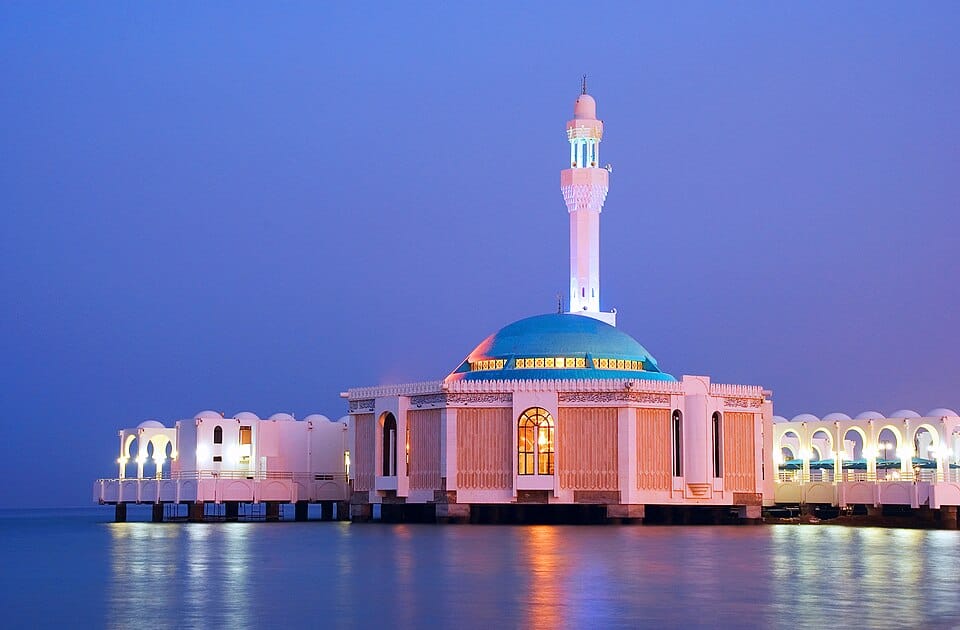
The mosque is one of Jeddah’s best-known landmarks and is often called the Floating Mosque because it stands over the Red Sea. It was built in 1985 and is connected to the mainland by a pathway. Its position over the water has made it both a functioning mosque and a well-known stop for visitors to Jeddah.
We had to park a little farther away than we expected, but I remember the walk toward the mosque being part of the experience rather than an inconvenience.
Children were playing nearby and the evening itself was quiet.
To reach the mosque, you cross the pathway over the water. We stopped a few times and looked down to see whether we could spot any fish beneath us. It was already dark and the water was not perfectly clear, but we could still make some out below.
Then we went inside for Maghrib.
What stayed with me most was not really the architecture. It was how peaceful the whole setting felt: the sea outside, the cooler interior of the mosque and the imam’s qira’ah during the prayer.
It turned what had simply been a stop because prayer time had arrived into one of the more memorable parts of the evening.

Water at Al Rahma Mosque
When I visited, bottled drinking water was available in refrigerators inside the mosque.
There was no one standing there distributing it. If you were thirsty, you could simply take a bottle, and there was no charge.
I always find something beautiful about that. Outside, you might find the same bottle of water being sold for a couple of riyals or more, while inside a mosque someone you may never meet has paid for it and left it there for anyone who needs a drink.
For me, little things like this are reminders to be grateful to Allah. Not everything has to be transactional. In Muslim culture, people regularly give water, food and other things hoping for reward from Allah in the akhirah, the afterlife, rather than expecting something back from the person receiving it.
Of course, I cannot say that bottled water will always be available at Al Rahma Mosque today. My visit was several years ago, and the brand or arrangements may have changed. But making drinking water freely available to worshippers is something you will come across in many mosques in Saudi Arabia.
If you are visiting the mosque during a longer Corniche walk, I would still carry your own water rather than assume it will be available.
What to bring for a Corniche walk
You do not need much, especially for an evening visit, but a few things make the experience more comfortable:
· comfortable walking shoes
· a bottle of water
· modest clothing, particularly if you expect to enter a mosque
· sunscreen and sun protection if you are visiting during daylight
· a little flexibility around prayer times
· a small bag or somewhere to keep your rubbish until you find a bin
For families, bringing your own water is even more useful because children may ask for drinks frequently once you start walking.
For an individual evening stroll, one bottle may be enough depending on the weather and how long you stay. For a family, group outing, school trip or event, it makes more sense to plan the quantity before leaving. For larger group requirements, Samar Water, a local supplier of bulk water cartons in Jeddah supplies bottled-water cartons in different brands and bottle sizes to homes, offices, schools, mosques, businesses and events across Jeddah.
That is particularly useful when one or two bottles bought individually from a stall turns into dozens of bottles for a group.
Don’t try to see the whole Corniche in one visit
Because the waterfront is so long, I would not approach Jeddah Corniche as something that needs to be “completed.”
Choose an area, walk for a while, stop when something catches your attention and allow the evening to develop naturally.
The official waterfront includes family spaces, play areas, public art and long walking routes, while other parts of the Jeddah coast offer different experiences altogether.
You can always come back another evening.
That is probably the best way to experience the Corniche anyway.
A quieter way to experience Jeddah
Visitors often build Jeddah itineraries around major landmarks, restaurants and shopping, and there is nothing wrong with that.
But an evening on the Corniche shows another side of the city.
Walk beside the Red Sea. Buy something small from one of the stalls. Watch the families and children around you. Stop when the adhan comes in. Pray if you are Muslim, take a break, drink some water, and then continue walking.
If Al Rahma Mosque is along your route, it is worth allowing enough time to stop rather than simply taking a photograph and leaving.
My own visit began only because Maghrib had arrived and we needed somewhere nearby to pray.
Years later, I still remember the walk over the water, looking down for fish, the cool interior of the mosque and the qira’ah during the prayer.
That is what I like about Jeddah’s Corniche: sometimes the most memorable part of the evening is the part you did not actually plan.
-sponsored-