
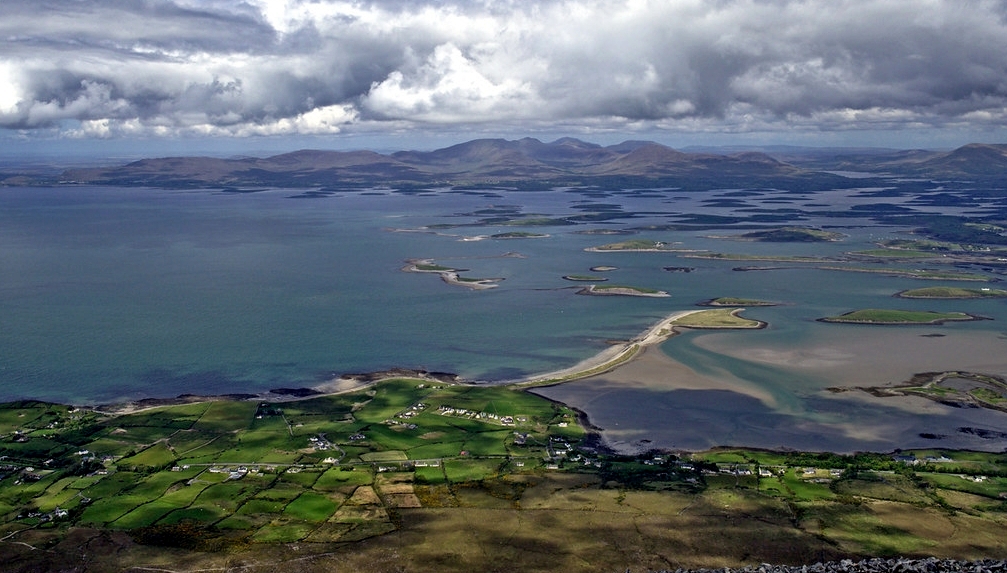
The Croagh Patrick (also known as “The Reek”), whose name means (St.) Patrick’s stack, is considered the holiest mountain in Ireland.
It is located in County Mayo on the Wild Atlantic Way, overlooking Clew Bay; 764 meters high, it is the 4th highest mountain in the region.
Since the Stone Age, the mountain has carried on a tradition of pilgrimage; still nowadays, every year (the last Friday and Sunday of July and the 15th of August) thousands of pilgrims ascend to the summit, where it is believed Saint Patrick fasted for forty days in 441 AD. According to tradition, the pilgrims should climb the mountain barefoot.
The view of Clew Bay and the charming town of Westport from the top is absolutely outstanding. The 7km round trip walk trail starts from the Murrisk car park.
Croagh Patrick also has a rather amusing geological connection with its most famous legend. The mountain contains distinctive light-green serpentinite, locally known as Snake Rock.
The rock is around 475 million years old and formed from ancient ultramafic rocks associated with oceanic crust and the Earth’s upper mantle, which were later altered by heat, pressure and water. The name serpentine itself comes from the Latin serpens, meaning snake, because of the rock’s characteristic green, mottled appearance.
The coincidence is particularly striking on a mountain where, according to tradition, St Patrick banished all the snakes from Ireland. In reality, there is no evidence that snakes ever lived naturally in Ireland after the last Ice Age, but the presence of “Snake Rock” on St Patrick’s mountain makes for one of the most curious geological and cultural coincidences in Ireland.