
Trips tend to begin with a tap on Save in Google Maps. A café recommended by a friend goes into Saved places. A museum from a travel newsletter or a viewpoint spotted in a video joins Want to go. A few months later, those lists hold 60 or 80 pins: some for the next trip, some for a vague “someday,” and a few you no longer remember saving.
Those lists are useful for collecting ideas, but not for deciding where to go once you’re there. The problem isn’t saving too much; it’s treating a growing collection as if it were already a trip plan.
A simple fix is to use two lists inside Google Maps: an inspiration map for collecting possibilities and a trip map for the places that fit this journey. In practice, each “map” is simply a saved list; you don’t need to build a custom map from scratch. The first can be untidy. The second should be small enough to make decisions for you.
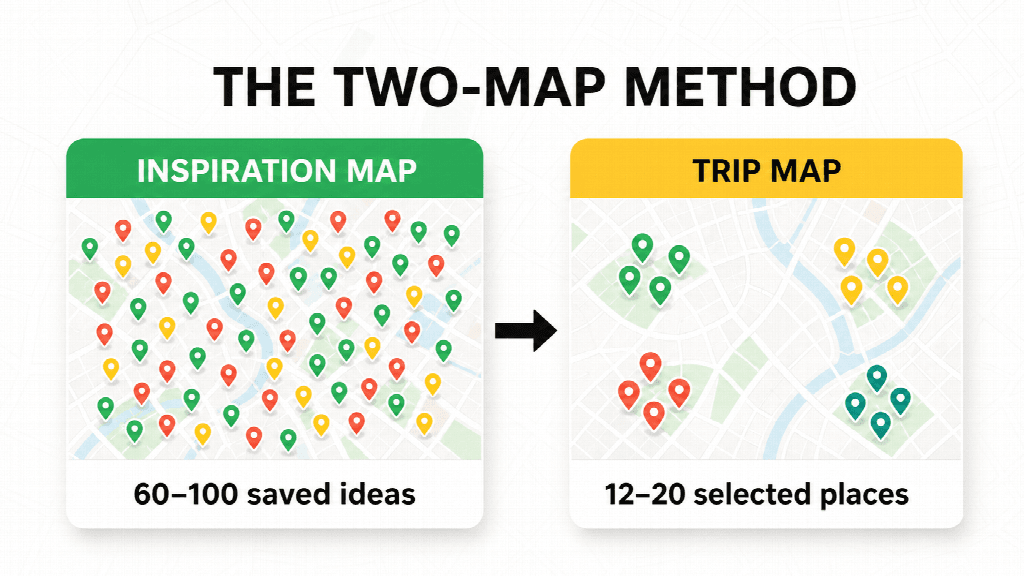
One saved list collects possibilities. A second, shorter list turns them into a plan.
Map one is allowed to be messy
The inspiration map is the list where you save first and judge later. It can include places from previous research, recommendations from friends, ideas for a future visit, and spots you may never get around to seeing.
Trying to organise every new pin the moment you save it turns travel research into admin. It also encourages premature decisions. A restaurant that seems too far away today may be perfect once you know where you’re staying. A coastal walk that doesn’t fit a winter weekend might become the main reason for returning in summer.
Use broad labels if they help: food, museums, outdoors, evening, rainy day. Don’t build a timetable yet. The purpose of this map is to stop good ideas from disappearing, not to promise that you’ll visit all of them.
It helps to add one short note when the reason for saving a place isn’t obvious. “Go before 9 a.m.” is more useful than a copied paragraph from a review. So is “cash only,” “book ahead,” or “view from the terrace.” Months later, you’ll still know why the pin mattered.
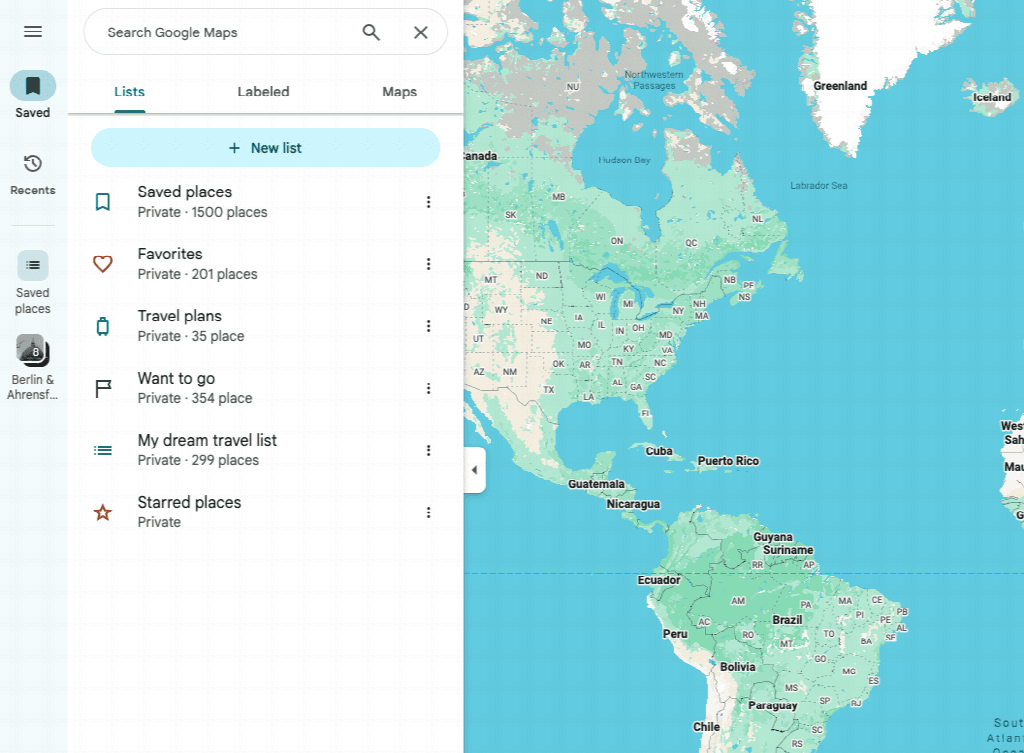
A saved list collects possibilities, but it still needs editing before it becomes an itinerary.
Map two has to earn every pin
The second list — the trip map — starts once the dates and accommodation are known. Instead of looking at all your saved places and asking, “Which ones do I like?”, ask a harder question: “Which ones fit this particular trip?”
Begin with the constraints that cannot move:
- arrival and departure times;
- accommodation location;
- booked tickets or tours;
- days when attractions are closed;
- the pace of the people travelling with you.
Now copy only the strongest candidates into the trip map. A place should survive because it’s important to you, because it sits naturally beside another stop, or because it solves a practical need such as lunch near a museum. Fame alone isn’t a reason to keep it.
Create a new Google Maps list with the destination and dates in its name, such as “Lisbon — 14–18 March.” A place can sit in more than one list, so adding it to the trip list doesn’t remove it from your inspiration collection. Google Maps doesn’t offer a bulk-copy command, though, so a long shortlist still has to be added one place at a time.
If the original list is long, ExportMyMap can export the places from your saved lists to a spreadsheet, making it easier to filter them by country, state or region before narrowing the collection to one trip.
This is where many plans improve dramatically. Two similar viewpoints become one. A restaurant requiring a forty-minute detour goes back to the inspiration map. A popular attraction may disappear because it consumes half a day you would rather spend elsewhere.
Removing a pin isn’t admitting that the research was wasted. It’s deciding that a future afternoon is worth more than a completed checklist.
Build days around neighbourhoods, not categories
Three museums on opposite sides of a city don’t make a sensible “museum day.” They make a day spent on buses between museums.
Once you have a short list, group places by area. Look for clusters that can be covered mostly on foot or with one straightforward journey. A morning market, a small gallery, two lunch options and a riverside walk in the same district already contain the shape of a good day.
This approach also makes the plan easier to change. If the gallery is unexpectedly closed, the rest of the cluster still works. If lunch takes longer than expected, you can skip the least important nearby stop without having to redesign the whole route.
Don’t trust the straight-line distance between pins. A river, railway, steep hill or limited crossing can turn two apparently close places into an awkward journey. Check the actual route, not just the pattern of markers.
Give each day one anchor
A useful day plan needs a centre of gravity. Choose one anchor: a timed museum ticket, a hike, a neighbourhood you especially want to explore, or a restaurant reservation. Everything else should support that anchor rather than compete with it.
For a city day, a comfortable structure might be:
- one anchor activity;
- two nearby places you would be happy to visit;
- one or two food options;
- an unplanned hour.
That last hour isn’t empty space. It covers the queue you didn’t expect, the shop you find on the way, the second coffee, or the simple fact that people walk more slowly on holiday. Without it, a minor delay at breakfast follows you until dinner.
Mark the anchor clearly on the trip map and treat the other pins as options. A map is excellent at showing where you could go. It shouldn’t make every pin feel compulsory.
Keep a Plan B close to Plan A
Bad-weather alternatives are often added as an afterthought: a list of indoor attractions scattered across town. That’s not much help when the rain starts and the nearest option is forty-five minutes away.
Attach a local backup to each day instead. If an outdoor morning is planned in one district, save a nearby market, church, gallery or café that could replace it. If the main attraction is closed, the day should bend rather than collapse.
Opening hours deserve a final check shortly before the trip. Saved map data can become stale, and smaller venues may change their schedule by season. Check the venue’s own website when a visit matters enough to shape the day. For restaurants, keep a second choice within the same area. Nobody enjoys making a committee decision about lunch while tired and hungry.
Make a version your travel companions can actually use
A private working list is fine while one person is planning. It becomes awkward when several people need the result. One person sends screenshots, another pastes names into a group chat, and somebody arrives with an older version of the plan.
Before leaving, create one read-only version that everybody can open. It doesn’t need your research notes or rejected ideas. It needs the selected places, useful details and a clear title. A printable copy is also handy for anyone who prefers paper and as a backup when a phone battery or mobile connection fails.
Once the trip map is ready, give the group one stable version instead of five competing ones. Depending on how people prefer to use it, that might be a shareable link, a printable PDF or a spreadsheet. The format itself matters less than making sure everyone has the same version.
If you choose a spreadsheet, sort places by neighbourhood, category or rating, then add columns for the planned day, priority, booking status and notes. The same approach works with a table created from any source.
A spreadsheet is also a practical starting point for AI-assisted planning. Give the model only the fields it needs, such as place names, areas, opening hours and your travel constraints, then ask it to cluster nearby stops or suggest a realistic order for each day. Treat the result as a first draft and check travel times, closures and reservations yourself.
Download the shared page or PDF before departure rather than assuming you’ll always have a signal. Keep booking confirmations separately, since a list of places isn’t a substitute for tickets or reservation details.
What this looks like on a four-day city trip
Imagine arriving with 62 saved places. They include bakeries, viewpoints, historic buildings, record shops, museums and restaurants collected over several months.
The trip has four real constraints: the first day starts after lunch, one museum is booked for the second morning, rain is likely on the third day, and the return journey begins late on the fourth afternoon.
After removing duplicates and places far outside the city, 38 pins remain. Grouping them by area reveals that several attractive stops sit nowhere near anything else. They return to the inspiration map. The final trip map contains 17 places:
- Day one: a short loop close to the accommodation, with dinner nearby;
- Day two: the booked museum as the anchor, followed by places in the same district;
- Day three: an indoor-heavy cluster with an outdoor alternative if the forecast improves;
- Day four: a flexible morning route that ends near the transport connection.
Seventeen places don’t mean visiting all seventeen. Some are alternatives. The important change is that every pin now has a reason to be on the map. At any point during the trip, the travellers can see a few suitable choices instead of reopening the full list of 62.
The original map hasn’t been deleted. It’ll still be there for an unexpected free afternoon or another visit.
The ten-minute check before you leave
The evening before departure, open the trip map once more and check the details that could waste time:
- Is the anchor for each day still open and operating at the expected time?
- Are timed tickets and reservations saved somewhere accessible offline?
- Does each day stay mostly within one part of the city?
- Is there a nearby alternative for bad weather or a closure?
- Can everyone in the group open the shared version?
- Has at least one person downloaded an offline map or printable copy? A comparison of five sharing formats covers links, PDFs, print and native Google Maps sharing.
Then stop planning.
A good travel map doesn’t prove how thoroughly you researched the destination. It removes small decisions when you’re already there. Keep the big collection for curiosity. Keep the trip map short enough to trust. The places you leave out aren’t failures; they’re what give the places you choose enough time to be memorable.