
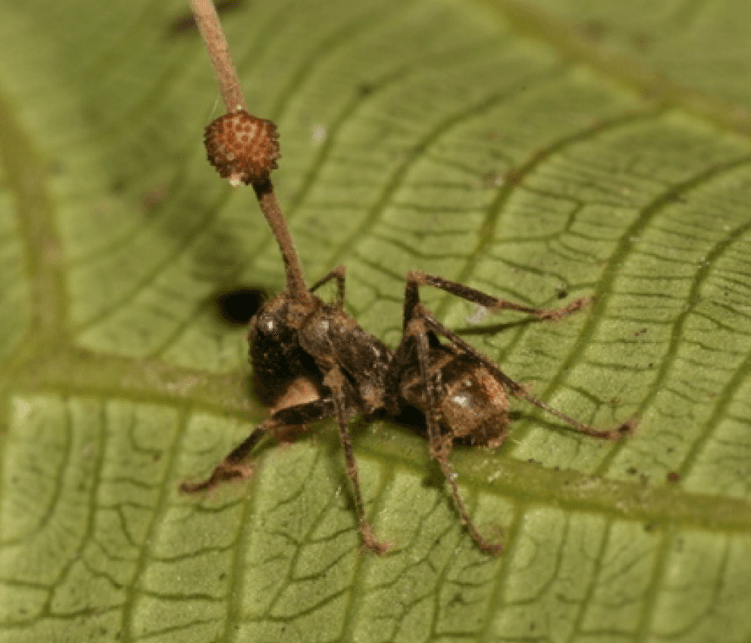
In the rainforests of southern Thailand, you can find something very strange under an ordinary leaf. A dead ant hangs there, its jaws locked onto the leaf, its legs spread out. A thin, pale stalk grows from the back of its head. The ant did not end up there by chance. It was sent there by the zombie ant fungus.
Its scientific name is Ophiocordyceps unilateralis, but this is really a group of similar fungi. Each type usually attacks one kind of carpenter ant. These fungi live in tropical forests around the world, from Brazil to China, but the best-known studies were made in Thailand, on an ant that lives high up in the trees.

How the zombie ant fungus takes control
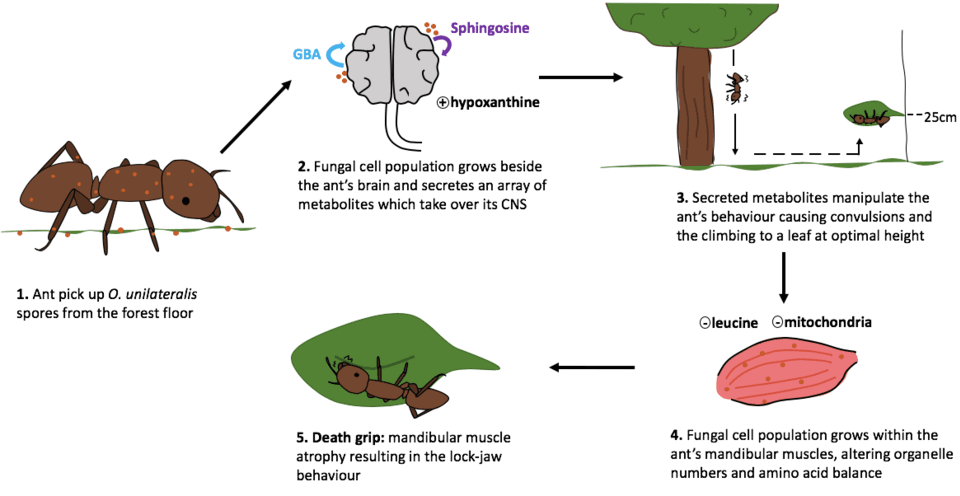
It all starts when a tiny spore lands on an ant and gets through its hard outer shell. Over the next two or three weeks, the fungus grows inside the ant’s body. Healthy ants of this kind live about 20 metres up in the trees and follow clear paths. Sick ants stop following the paths. They walk around as if they were drunk, shake, and fall to the ground. Once there, they can’t find their way back up.
Then the fungus makes the ant do something very exact. Around midday, when the sun is highest, the ant climbs a small plant and bites hard into the main vein under a leaf. This leaf is almost always about 25 cm above the ground, often on the north-west side of the plant. At this height the air is warm and damp, which is just what the fungus needs. When scientists moved sick ants higher up, the fungus didn’t grow properly. The ant’s jaw muscles then weaken in a way that keeps its mouth shut, so it can’t let go. This is known as the death grip. The ant usually dies around sunset. The fungus then sticks the body to the leaf and slowly grows a stalk, which drops spores on the ants walking below. Because the right spots are few, the dead ants end up close together in small areas that scientists call graveyards.
For a long time, people thought the fungus grew inside the ant’s brain. A 2017 study from Penn State University showed that this isn’t quite true. The fungus spread all through the ant’s body and wrapped around its muscles, but it did not grow inside the brain. Instead, it seems to control the brain from the outside. Other studies found that the fungus gives off chemicals that change how the ant’s brain and nerves work. So the fungus works on two fronts: chemicals that change the ant’s behaviour, and a grip on the muscles that move its body, right up to the final bite

A very old story
This has been going on for a very long time. A fossil leaf found at the Messel Pit in Germany, a UNESCO World Heritage site, shows the same bite marks. The leaf is about 48 million years old.
In 2011, scientists working in the Atlantic Forest of Brazil found that what they thought was one fungus was actually four different ones, each attacking a different ant. In Brazil the ants seem to bite at night instead of at midday, and the height of the leaf changes more. The fungus has its own enemies too: other fungi can grow on the dead ants and destroy it. People don’t need to worry. Each fungus is so closely matched to its ant that it can’t attack humans, even though it inspired the video game The Last of Us.
In 2011, scientists working in the Atlantic Forest of Brazil found that what they thought was one fungus was actually four different ones, each attacking a different ant. In Brazil the ants seem to bite at night instead of at midday, and the height of the leaf changes more. The fungus has its own enemies too: other fungi can grow on the dead ants and destroy it. People don’t need to worry. Each fungus is so closely matched to its ant that it can’t attack humans, even though it inspired the video game The Last of Us.
Where to see zombie ants in Thailand
There is no marked path to a zombie ant, so you’ll need patience and good eyes. The fungus likes warm, wet rainforest, and the green hills around Krabi have plenty of it. Khao Phanom Bencha National Park, about 20 km north of Krabi Town, is a good place for jungle walks. Look under the leaves of small plants at about knee height, in shady, damp spots away from the main paths. A local guide will help a lot, but there’s never a promise you’ll find one.
The rainy months, from about May to October, are the dampest, which suits the fungus, and the trails are quieter too. There are many flights from Bangkok to Krabi, and the park is a short drive or scooter ride from town. If you do spot an ant frozen under a leaf with a thin stalk coming out of its neck, you’re looking at a trick nature has used for 48 million years.