Travel and Confucianism: Following the Wisdom of Confucius Across East Asia

When we travel through East Asia – from ancient temples in China to serene courtyards in Hanoi – we often step into the lingering presence of a man who lived more than 2,500 years ago: Confucius. His teachings helped shape the cultural and moral foundations of an entire region, and even today, travelers unknowingly walk paths laid down by his philosophy.

Confucius, born in 551 BCE in the state of Lu (present-day Qufu, China), was a scholar, philosopher, and teacher. Known in Chinese as Kong Fuzi (Master Kong), he came from a modest background and devoted his life to education, ethics, and the improvement of society. He served briefly as a political advisor but found his true calling in teaching and traveling, sharing his ideas with a group of loyal disciples.

It’s important to clarify: Confucius was not a god, nor did he claim divine status. He was fully human — a thinker whose ideas, rooted in respect, loyalty, and virtue, deeply resonated with generations to come.

Confucianism is best understood as a philosophical and ethical system, not a religion in the traditional sense. It has no god, no clergy, and no rituals of worship. However, it includes spiritual elements such as ancestor veneration, ceremonial respect, and moral discipline, which have often placed it in the realm of religious traditions, especially in Chinese culture.

The core teachings of Confucius were recorded by his students in The Analects, a collection of dialogues and reflections that form the foundation of Confucian thought. In this book, Confucius emphasizes:

  • Ren (仁) – Compassion and humaneness toward others.
  • Li (礼) – Proper conduct, rituals, and respect in social interactions.
  • Xiao (孝) – Filial piety, or deep respect for one’s parents and ancestors.
  • Yi (义) – Righteousness and doing what is morally right.
  • Zhi (智) – Wisdom and discernment.
  • Zhong (忠) – Loyalty.
  • Shu (恕) – Reciprocity – treating others as you wish to be treated.

These values aren’t abstract ideals – they are intended as practical guides for daily life, offering a roadmap for building personal character and social harmony.

Confucianism remains a powerful cultural force across East Asia, particularly in China, Korea, Japan, and Vietnam. While fewer people today would call themselves Confucian in a religious sense, the philosophy still influences social norms, education systems, and family structures. It is estimated that over six million people worldwide identify with Confucianism in some formal way, though its cultural influence extends far beyond these numbers.
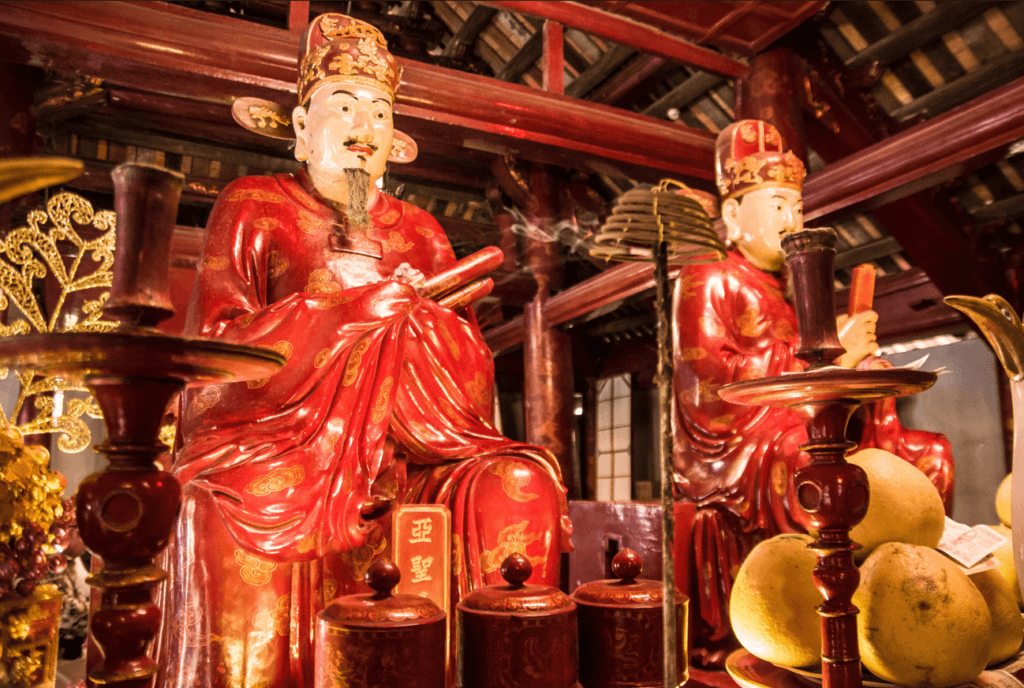
Temple of Literature, Confucius
Temple of Literature, Hanoi – photo © mytouristmaps

In China, Confucian classics are being reintroduced into school curricula. In South Korea, Confucian values continue to shape hierarchies in family and corporate life. In Japan, it has long influenced education and respect for elders.

Vietnam, with its rich blend of indigenous culture and Chinese influence, has long embraced Confucian ideals. Nowhere is this more evident than in Hanoi’s Temple of Literature (Văn Miếu), a serene, beautifully preserved complex built in 1070 and dedicated to Confucius. It later became Vietnam’s first national university, the Imperial Academy (Quốc Tử Giám), where scholars studied Confucian texts in preparation for civil service exams.
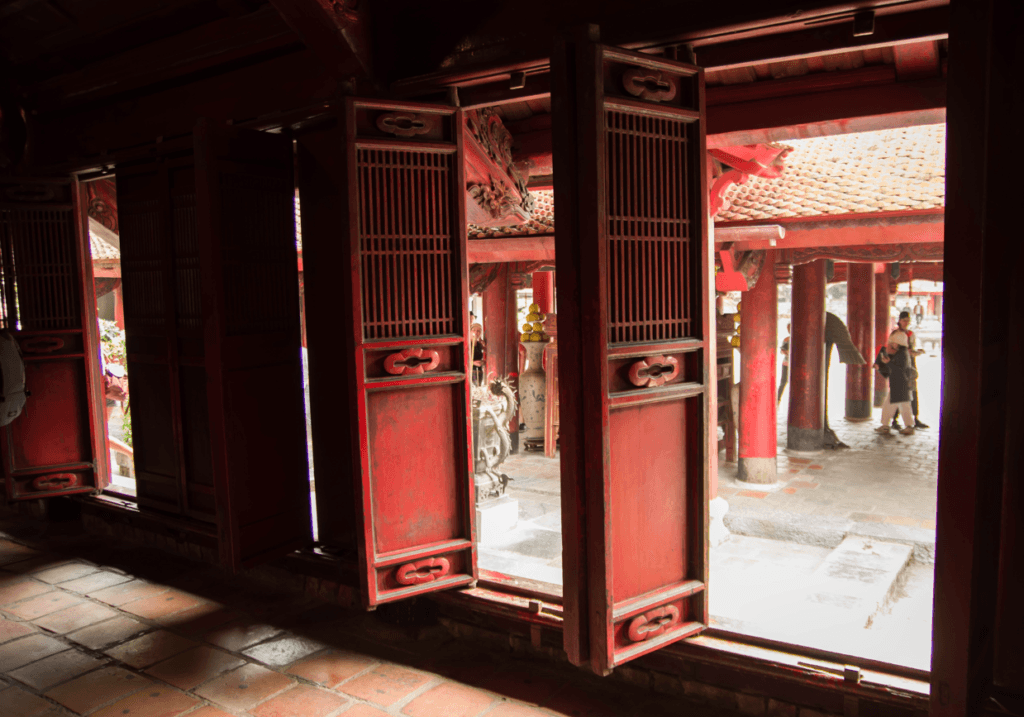
Temple of Literature, Confucius
Temple of Literature, Hanoi – photo © mytouristmaps

Although modern university curricula in Vietnam no longer center around Confucian classics, the legacy of Confucian education is honored at the Temple of Literature. Many students still visit before important exams to pray for wisdom and success. The site remains a popular cultural symbol, reminding visitors of Vietnam’s scholarly traditions and the enduring influence of Confucian values like respect for teachers, learning, and social responsibility.

For the mindful traveler, understanding Confucianism can lead to deeper cultural insight. When you notice multi-generational families dining together, or when your Vietnamese host insists you sit before they eat – you’re witnessing Confucian values in action. These subtle expressions of respect and harmony are woven into the social fabric, guiding interpersonal relations even in the most modern settings.

Travel, in many ways, is an act of learning. And as Confucius once said: “Is it not a pleasure to learn and, when it is timely, to practice what you have learned?”

Purmamarca Hills, Argentina

The hills around Purmamarca always surprise travellers, even those who have seen photos before arriving. From the edge of this quiet Andean village in northern Argentina, the Cerro de los Siete Colores rises in a series of soft layers painted in reds, greens, violets and pale yellows. In the early morning light, before the sun climbs above the valley, the colours look sharper and fresher, as if they were recently brushed across the rock.

Each tone corresponds to a sediment layer formed under different conditions millions of years ago. The reds usually come from iron oxides, the greens often from copper minerals, the purples from manganese, and the lighter creams from ancient marine or lake deposits rich in calcium carbonate or sulphur. Over time, these sediments hardened into rock. Later, as the Andes rose, the layers were tilted and exposed, leaving them stacked diagonally like the pages of an open book.

Purmamarca Hills
photo by Tanenhaus/Flickr

Walking through Purmamarca, with its adobe houses and calm streets, gives you time to absorb the landscape. The Paseo de los Colorados, an easy loop behind the hills, lets you get close to the rock faces and see how the texture changes from one colour band to the next. Higher viewpoints around the village offer a wider, more dramatic perspective across the valley and the multicoloured slopes.

Getting here is simple enough. San Salvador de Jujuy lies about an hour away by road, and Salta is roughly a three-hour drive. Many people visit on a day trip, but staying overnight is worthwhile if you want to watch the hills shift in tone at sunset and again in the early morning.

The dry season, from May to October, is the ideal time to visit. Clear skies make the colours stand out more sharply, and the temperatures are comfortable during the day, though the altitude keeps nights on the cooler side. In the summer months, rain can soften the colours a little, but the scenery remains impressive.

Travellers sometimes compare Purmamarca to other “rainbow” landscapes around the world, and it’s an interesting comparison because the similarities are superficial while the geology differs quite a bit. The Rainbow Mountain in Peru (Vinicunca) shows striking stripes of red, turquoise and gold, but its colours are the result of different mineral compositions—red claystone rich in iron, yellow sandstone with sulphur, and green tints from chlorite. The mountain also sits at a much higher altitude than Purmamarca, which means far harsher weather and a more demanding hike to reach the viewpoint.

China’s Zhangye Danxia landforms offer yet another variation. The striped hills there come from layers of sandstone deposited over millions of years and then weathered into smooth, wave-like shapes. The colour patterns are extremely regular and linear, giving the area a very different appearance from the softer, more irregular bands around Purmamarca. While all three sites feature multicoloured rock, each was shaped by different geological processes and environmental conditions, which is why the patterns, and even the style of colour, feel unique in each place.

What makes Purmamarca special is this combination of geology and atmosphere. The coloured hills rise directly behind a tiny village where life moves slowly, and the desert air seems to bring out subtle shades that photos rarely capture. Standing there, with millions of years of earth history right above the rooftops, you feel a connection to the landscape that goes beyond the colours themselves.

Shanay-Timpishka, Peru

Shanay-Timpishka is a rare geothermal river located in the Huánuco region of Peru, within the Amazon rainforest near Pucallpa. Commonly referred to as the boiling river, it is one of the few known rivers where water naturally reaches exceptionally high temperatures over several kilometres. In various sections, the water can reach from around 50°C to nearly boiling. Unlike most geothermal sites, Shanay-Timpishka is not situated near any volcanic system. Its high temperatures result from deep geological faults that allow groundwater to circulate, heat up through geothermal energy, and return to the surface, warming the river along its course. This unusual configuration has made the area a subject of scientific interest, particularly following research carried out by geoscientist Andrés Ruzo.

Shanay-Timpishka
photo by Wikimedia Commons

The river is also culturally significant for the Asháninka community who live in the surrounding forest. Their retreat centre, Mayantuyacu, manages access to the river and serves as a base for visitors interested in traditional plant medicine, ecological practices and guided visits. Because the temperatures can be hazardous, exploring the river always requires local guidance to ensure safety.

Reaching Shanay-Timpishka usually begins in Pucallpa, which is connected to Lima by daily flights of about one hour. From Pucallpa, the journey continues by road toward Honoria, often in a 4×4 vehicle arranged through a local guide or directly with the Mayantuyacu retreat. The final approach requires a short hike through the forest to reach the centre and the river. Access is not available for unguided visits; travellers must book in advance through Mayantuyacu or a recognised local operator for safety and for respect of the cultural and environmental management of the area.

The best period to visit the river is generally from May to September, during the drier season in the Peruvian Amazon, when trails are easier to access and transport logistics are more reliable. The rainy season, from November to March, also offers some advantages. Water levels are higher, and in some parts the temperature of the river decreases slightly due to the increased flow, allowing safe bathing only in selected areas and always under supervision. However, rain can make travel and trekking more difficult.

Visitors should bring lightweight clothing suitable for rainforest conditions, insect protection and appropriate footwear for muddy trails. Swimming is allowed only where temperatures are safe and only with authorised local staff. Photography is usually permitted, although some areas around Mayantuyacu may have cultural or environmental restrictions.

Shanay-Timpishka is a scientifically valuable geothermal feature and an important cultural site within the Peruvian Amazon. Its thermal characteristics, its role within Asháninka territory and its carefully managed access make it an interesting destination for travellers focused on geology, ecology and responsible tourism.

Sea Whirlpools

Whirlpools (or maelstroms) are some of the most dramatic and photogenic behaviours of the sea: spinning columns, boiling “boils” and eddies that twist surface foam into rings.

They are not monsters from myth, but the result of predictable fluid dynamics: tides, currents, and the shape of the coastline and seafloor.

At a basic level, a strong whirlpool needs three things: a lot of water moving past a bottleneck, a sudden change in depth or underwater obstacle, and rapidly changing flow (usually tidal). Exactly the same thing that happens when you empty your bathtub after a nice bath with sea salt and essential oils.
When huge volumes of water are forced through a narrow strait or over an uneven seabed, the flow becomes turbulent. That turbulence and shear produce rotating currents that can line up into vortices visible at the surface. Where an opposing flow, underwater pinnacles or abrupt depth changes exist, standing eddies, “boils” and persistent vortices form; when tides reverse, they can re-energise and reshape the whirlpool every few hours.

Walter Baxter / The Corryvreckan Whirlpool

Where to see them

  • Saltstraumen, Norway — one of the strongest tidal currents on Earth; enormous volumes of water squeeze through a narrow strait, producing vortices and intense turbulence.
  • Moskstraumen / Maelstrom, Norway (Lofoten area) — the classic “maelstrom” of legend; a system of tidal eddies between the Norwegian Sea and Vestfjorden formed by strong currents and complex bathymetry.
  • Naruto whirlpools, Japan (Naruto Strait) — spectacular, regularly visible whirlpools caused by tidal exchanges between the Inland Sea and the Pacific; eddies can reach many metres across and are a major sightseeing attraction with boat and bridge viewpoints.
  • Gulf of Corryvreckan, Scotland — a turbulent whirlpool in the strait between Jura and Scarba driven by tides, a deep sea hole and an underwater pinnacle; famous for violent surface boils and as a challenging spot for boats.
  • Old Sow, Bay of Fundy (between New Brunswick, Canada and Maine, USA) — the largest tidal whirlpool in the Western Hemisphere; formed where powerful Bay of Fundy tides meet local bathymetry. Locally notorious and often called the “Sow.”
  • Seymour Narrows / Discovery Passage, British Columbia (Canada) — a narrow passage with very strong tidal currents and frequent turbulence; historically dangerous to shipping (Ripple Rock) and still a site of strong eddies and boils.
  • Strait of Messina, Italy (Scylla & Charybdis legend) — the geology and colliding currents create local whirlpools referenced in Greek myth; a historically famous example of a Mediterranean whirlpool area.
  • Skookumchuck Narrows, British Columbia (Canada) — dramatic tidal rapids and standing waves that occur when huge tidal volumes rush through a constricted channel; smaller whirlpools and strong boils form at peak flow and draw kayakers and spectators.

Campo de Piedra Pómez, Catamarca, Argentina

Tucked away in the high-altitude desert of Catamarca, Argentina, the Campo de Piedra Pómez is one of the most surreal and remote landscapes in South America. Stretching across more than 75,000 hectares in the Puna de Atacama, this protected area is home to a massive field of white and pale pink pumice stone formations, sculpted by volcanic eruptions and shaped by millennia of wind erosion. What visitors find here is a silent stone labyrinth that looks more like a forgotten planet than part of our own world.

Campo de Piedra Pómez
photo by Rodolfo Pace/Flickr

The entire area was formed over 100,000 years ago by the violent activity of nearby volcanoes, especially Volcán Blanco (also known as Robledo), whose caldera can still be visited today. The explosive eruptions created vast flows of ignimbrite — a mixture of ash, pumice and gases — which later hardened into stone and were slowly eroded by puna winds. The result is a frozen sea of rock waves, towers and natural sculptures that stretch as far as the eye can see, at altitudes ranging from 3,050 to 4,850 meters above sea level.

Although it was declared a protected natural area in 2012, the Campo de Piedra Pómez still lacks proper conservation infrastructure. Only three park rangers cover the entire region, with some stationed over 80 km from the site. In recent years, increasing tourist traffic and the threat of mining activity in surrounding dunes have placed pressure on this fragile ecosystem. Despite its protected status, the landscape remains vulnerable.

Reaching this hidden treasure is not easy. The closest village is El Peñón, located about 60 kilometers south of Antofagasta de la Sierra, the departmental capital. Both are accessible only by unpaved roads, and a high-clearance 4×4 vehicle is essential. The journey is long and remote, but offers unforgettable views of volcanic plains, salt flats and wide-open skies. From El Peñón, travelers can arrange guided excursions with local drivers who know the terrain. Some tours also include other natural highlights in the region, such as Laguna Grande or the Balcones de Laguna Purulla.

There are no hotels or tourist infrastructure in the pumice field itself, and even in El Peñón lodging is basic. A few guesthouses offer simple rooms and homemade meals, often run by families who also act as guides. For more comfort, travelers can choose to stay in Antofagasta de la Sierra, which has more services, fuel and accommodation options. Wild camping inside the protected area is discouraged, both because of conservation concerns and because of the isolation and unpredictable weather conditions.

The best time to visit is during the dry season, from April to November. During these months, the sky is usually clear and the roads are more accessible. Daytime temperatures can be warm under the sun, but nights are cold year-round, often dropping below freezing. The summer months, from December to March, bring occasional thunderstorms that can wash out roads and make travel dangerous. Regardless of the season, visitors should bring plenty of water, sun protection, warm clothing and offline maps or GPS.

Several scenic areas within the stone field have become informal circuits over time. Among the most impressive are the Gigantes de Piedra Pómez, towering formations that resemble waves of solidified air, and the La Lagunita Escondida, a small hidden lagoon nestled between rock walls. The area’s remoteness and altitude also make it a dream destination for stargazers — with no light pollution and dry, crisp air, the Milky Way is often clearly visible to the naked eye.

Visiting Campo de Piedra Pómez is not about ticking a box or taking a quick photo. It is an experience of solitude, scale and silence. It’s a destination that demands effort and respect, but rewards those who make the journey with an unforgettable encounter with nature’s raw and ancient forces. This is not a place to pass through — it’s a place to feel.

Eisriesenwelt, The World’s Largest Ice Cave, Austria

Tucked away in the Tennengebirge mountains near Werfen, about 40 km south of Salzburg, lies one of Austria’s most extraordinary natural wonders: the Eisriesenwelt, or “World of the Ice Giants.” Stretching more than 42 kilometres, it is the largest ice cave on the planet. Only the first kilometre is covered in shimmering ice, but this section alone feels like stepping into a frozen fairy tale of crystal palaces, frozen cascades, and immense icy sculptures.

Eisriesenwelt
Cartographer 89CC BY-SA 3.0 AT, via Wikimedia Commons

A Natural Wonder Carved by Time

The cave was formed over millions of years as water slowly hollowed out the limestone rock. During the cold winter months, icy winds push into the caverns, freezing the water that seeps in from the surface. The result is a constantly evolving wonderland of frost and ice, with formations that shift subtly from year to year.

It’s important to note that while the cave remains below freezing year-round, the most spectacular ice formations are seasonal. The cave is open to visitors from May to October, when the ice is stable and safely accessible. In winter, the cave remains closed due to snow, ice, and safety hazards, so visitors cannot explore it at that time.

The Journey to the Entrance

Reaching Eisriesenwelt is an adventure in itself. From the village of Werfen, famous for its medieval Hohenwerfen Castle, visitors travel up a steep mountain road before boarding Austria’s steepest cable car. The ride glides high above the valley, delivering breathtaking views of the Salzach River below. A short but scenic hike leads to the cave entrance, perched dramatically at 1,641 meters above sea level.

Once inside, guides lead groups through chambers lit by flickering carbide lamps. The silence, interrupted only by the sound of water droplets and footsteps crunching on the frozen floor, creates a hauntingly beautiful atmosphere. Highlights along the route include the Posselt Hall, the first chamber discovered in 1879, and the spectacular Ice Palace, where towering formations resemble a cathedral carved entirely from ice.

Practical Tips

  • When to visit: The cave is open from May to October. In winter it remains closed due to hazardous ice conditions.
  • What to wear: Warm clothing, sturdy shoes, and gloves are essential, even in summer, temperatures inside never rise above freezing.
  • Tours: Visits are only possible with a guide and take about 75 minutes. Photography is restricted inside, which helps preserve the unique atmosphere.
  • Getting there: Werfen is a 40-minute train or car ride from Salzburg. From the village, shuttle buses, a cable car, and a short hike complete the journey.

Why Eisriesenwelt Should Be on Your Map

The Eisriesenwelt is more than just a cave, it’s a journey into another world. Few experiences combine such raw natural power, Alpine adventure, and sheer beauty. For anyone travelling through Austria, this icy underworld is a stop that promises to stay with you long after you leave the mountains behind.

Cormorant Fishing: A Fascinating Union of Nature and Tradition

Cormorant fishing is an ancient practice that showcases the unique relationship between humans and animals in traditional ways of life. Practised for over a thousand years in East Asia, this technique involves using trained cormorants to catch fish, especially in rivers. Today, the tradition continues mainly as a cultural performance, but it remains a captivating experience for travellers and a subject of interest for wildlife enthusiasts.

Cormorant fishing is a technique in which cormorants are trained to dive into rivers and retrieve fish for their handlers. A loose ring is often tied at the base of the bird’s neck, which prevents it from swallowing larger fish. These are then collected by the fisherman. Smaller fish can be swallowed by the bird as a reward.

This form of fishing requires deep expertise and a strong bond between the bird and the handler. It is often performed at night, with fires placed at the front of the boat to attract fish and light up the water.

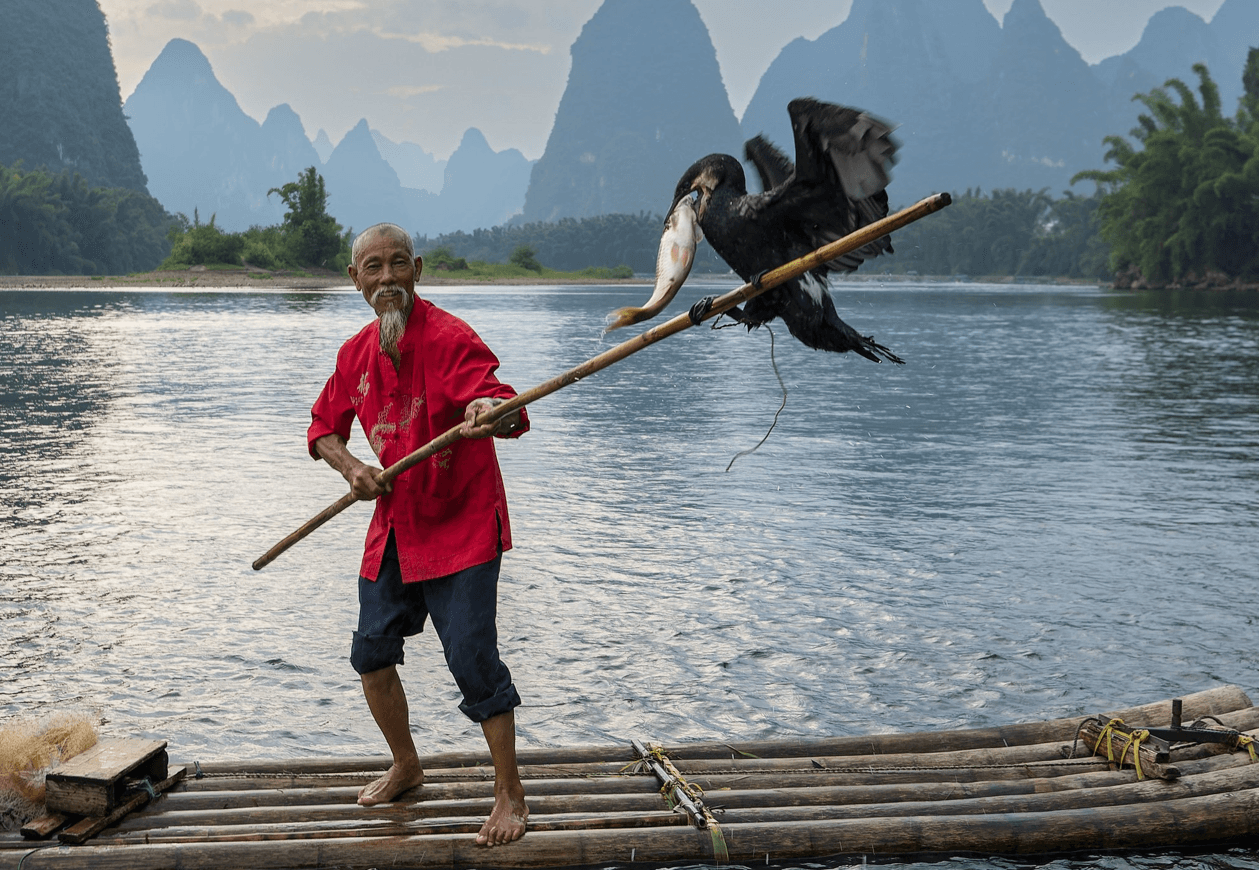
Cormorant fishing, China
Cormorant fishing, Yangshuo, China – photo © Rod Waddington

Cormorants belong to the family Phalacrocoracidae, which includes about 40 species found in aquatic environments around the world. The species most commonly used in fishing is the Japanese cormorant, scientifically known as Phalacrocorax capillatus. The Great Cormorant, Phalacrocorax carbo, is also used in some regions.

Cormorants are skilled divers (can dive as deep as 45 meters) with streamlined bodies, webbed feet for powerful swimming, and a hooked bill that helps grip slippery fish. Unlike most aquatic birds, cormorants do not have waterproof feathers. This makes them more effective divers, but also means they must spend time drying their wings after fishing.

Although modern fishing has replaced this technique in everyday life, cormorant fishing continues as a cultural tradition supported by tourism and local pride. The following are the best-known places where you can still witness this rare practice.

Japan – Gifu City on the Nagaragawa River
Best time to visit: May 11 to October 15
Gifu is the most famous location in Japan for traditional cormorant fishing, known as Ukai. The fishermen wear traditional robes and guide long wooden boats under the glow of open flames. This practice has been protected and sponsored by the Japanese Imperial Household for centuries. Visitors can watch from specially designed viewing boats.

China – Guilin and Yangshuo in Guangxi Province
Best time to visit: All year, especially from October to March
Cormorant fishing is sometimes demonstrated along the Li River, particularly for tourists during sunset. These performances recreate an ancient tradition that dates back to the Tang Dynasty. While it is no longer used for subsistence, it remains a visually stunning and symbolic display.

China – Xingping Ancient Town along the Li River
Best time to visit: October to April
Xingping is a quieter and more authentic spot to observe cormorant fishing. The town’s old architecture and calm river atmosphere provide a perfect backdrop for the experience.

China – Erhai Lake in Yunnan Province
Best time to visit: March to May
In this area, the practice is still known among the Bai ethnic minority. While rarer today, it is occasionally performed in cultural events and local festivals.

Vietnam once saw cormorant fishing in the Red River Delta, though it is now nearly extinct. Some ethnic groups in rural areas may still train birds for symbolic or ceremonial purposes.
In medieval Europe, cormorants were trained in England and France, more as a royal sport than a means of fishing.

Cormorant fishing is not just a way to catch fish. It represents a deeper philosophy of coexistence between people and nature. In Japan, the head fisherman, called Usho, is often seen as a guardian of the river’s spirit. In China, the practice has inspired poets, painters, and storytellers for centuries.
Today, conservationists ensure that trained cormorants are treated with care. They are fed properly, given regular rest, and often live longer than their wild counterparts due to veterinary support and the absence of natural predators.