
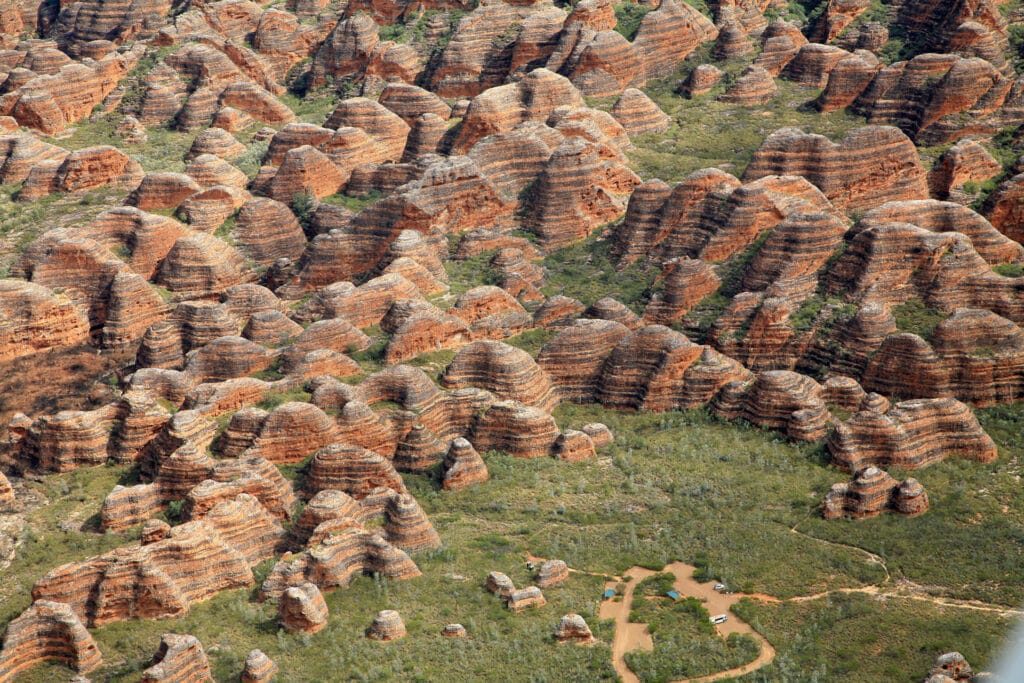
Hidden in the remote Kimberley region of Western Australia, Purnululu National Park is home to one of the world’s most extraordinary geological landscapes. Famous for the iconic Bungle Bungle Range, the park features thousands of beehive-shaped sandstone domes striped with vivid orange and dark grey bands, creating a landscape unlike anywhere else on Earth.
Despite being one of Australia’s greatest natural treasures and a UNESCO World Heritage Site, Purnululu remains surprisingly little visited due to its isolated location. Those who make the journey are rewarded with spectacular hikes, dramatic gorges, Aboriginal cultural heritage and unforgettable aerial views.

Why Visit Purnululu National Park?
Unlike Australia’s more famous destinations such as Uluru or the Great Barrier Reef, Purnululu National Park offers an authentic wilderness experience. The park’s remoteness has preserved its pristine environment, allowing visitors to explore breathtaking landscapes without large crowds.
The highlight is undoubtedly the Bungle Bungle Range, an immense collection of sandstone domes that extends for over 450 square kilometres. Walking among these ancient formations feels like stepping onto another planet.
The Geology Behind the Bungle Bungle Range
The remarkable striped domes are approximately 350 million years old and were formed from layers of sandstone deposited by ancient rivers during the Devonian Period.
Over millions of years, erosion sculpted the soft sandstone into the distinctive rounded towers seen today.
The striking colours result from different biological and mineral processes:
- The bright orange bands contain iron oxide and dry rapidly after rainfall.
- The darker grey bands retain more moisture, allowing cyanobacteria to grow on the surface.
Together, these alternating layers create the famous “tiger stripe” appearance visible across the entire range.
The domes generally rise between 200 and 300 metres above the surrounding plains, creating one of the most unique geological landscapes on Earth.
Aboriginal Heritage
The park lies within the traditional lands of the Kija and Jaru peoples, who have lived in this region for tens of thousands of years.
For Indigenous Australians, Purnululu is far more than a geological wonder. Numerous rock shelters, ceremonial sites and ancient artworks demonstrate the deep spiritual connection between the Traditional Owners and this landscape.
The name “Purnululu” is believed to derive from the Kija language, although its precise meaning remains uncertain.
Today, the park is jointly managed with Aboriginal communities, who continue to play an essential role in preserving its cultural heritage.
Cathedral Gorge
One of the park’s most famous attractions is Cathedral Gorge, an enormous natural amphitheatre carved into the sandstone.
After a relatively easy walk through narrow passages between towering domes, visitors reach a circular chamber with nearly vertical walls that create remarkable acoustics. Following seasonal rains, a small pool forms at the base, reflecting the surrounding cliffs.
The silence and natural echo make Cathedral Gorge one of Australia’s most memorable geological sites.
Echidna Chasm
Located in the northern section of the park, Echidna Chasm offers a completely different experience.
The narrow canyon, in places less than one metre wide, is enclosed by vertical rock walls reaching nearly 200 metres high. Around midday, sunlight penetrates the chasm, illuminating the sandstone walls with spectacular shades of orange and gold.
The hike is relatively short but provides some of the park’s most dramatic scenery.
Piccaninny Creek
For adventurous hikers, Piccaninny Creek provides access deep into the heart of the Bungle Bungle Range.
The creek has carved broad valleys between the sandstone domes, offering opportunities for longer day hikes and overnight treks. Walking through this remote landscape allows visitors to fully appreciate the immense scale of the ancient rock formations.
Wildlife
Although the landscape appears harsh, Purnululu supports a surprising diversity of wildlife.
Visitors may encounter:
- Agile wallabies
- Euros (common wallaroos)
- Dingoes
- Short-beaked echidnas
- Numerous reptiles
- More than 130 bird species, including cockatoos, parrots and birds of prey
Many animals are most active during the cooler early morning and late afternoon hours.
Scenic Flights
One of the best ways to appreciate the vastness of Purnululu National Park is from the air.
Scenic helicopter and small aircraft flights reveal the incredible scale of the striped domes, winding gorges and surrounding wilderness. From above, the Bungle Bungles resemble thousands of giant beehives stretching across the landscape.
Many visitors consider the flight to be one of the highlights of their trip to Australia.
Best Time to Visit
The park is generally open between April and October, during the dry season.
The best months are:
- May to August for cooler hiking temperatures.
- September for warm weather with fewer visitors.
During the wet season, typically from November to March, heavy rainfall often closes the access road and the park becomes inaccessible.
How to Get There
Reaching Purnululu National Park requires some planning due to its remote location.
Most visitors drive from either Kununurra (approximately 300 km) or Halls Creek (approximately 100 km to the park entrance).
The final 53 kilometres consist of a rough four-wheel-drive track that usually takes around two hours to complete. A high-clearance 4WD vehicle is strongly recommended.
Alternatively, scenic flights depart from both Kununurra and Warmun, providing access for visitors who prefer not to drive.
Visitor Tips
Carry plenty of drinking water, as temperatures can exceed 35°C even during the dry season.
Fuel stations are limited in the Kimberley region, so fill your vehicle before entering the park.
Mobile phone coverage is extremely limited or unavailable.
Camping facilities are available inside the park, while additional accommodation can be found in Kununurra, Warmun and Halls Creek.
Interesting Facts
- The Bungle Bungle Range remained largely unknown outside Aboriginal communities until the early 1980s.
- The park became a UNESCO World Heritage Site in 2003.
- More than 130 bird species have been recorded within the park.
- Some sandstone layers date back over 350 million years.
- The famous striped appearance is caused by moisture differences and cyanobacteria growing on the darker bands.
- Several movies, documentaries and travel productions have featured the Bungle Bungles because of their otherworldly appearance.