
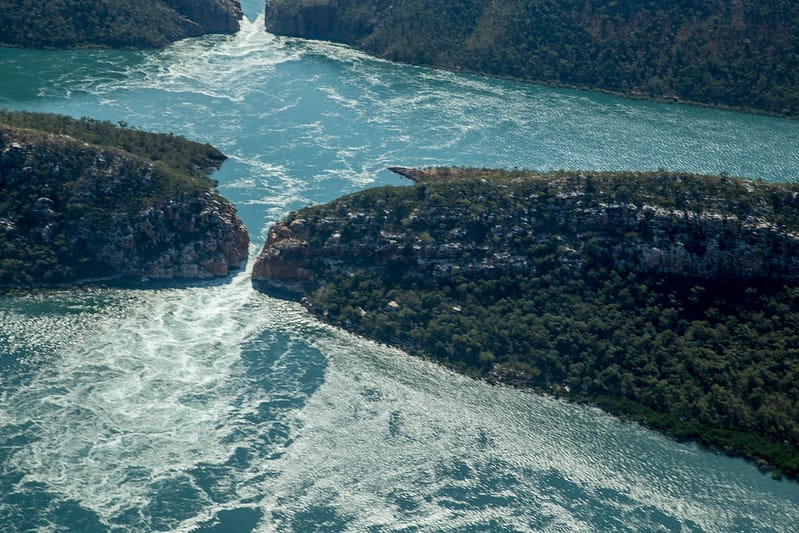
Located in the remote Kimberley region of Western Australia, the Horizontal Falls, also known as Garaanngaddim, are among the country’s most peculiar natural attractions. Despite their name, they are not true waterfalls but a unique tidal phenomenon where enormous volumes of seawater are forced through two narrow coastal gorges, creating powerful horizontal torrents that resemble rivers flowing sideways.
Described by naturalist Sir David Attenborough as “one of the greatest natural wonders of the world,” the Horizontal Falls offer visitors an unforgettable combination of dramatic scenery, thrilling boat rides, and one of the largest tidal movements on Earth.
The Horizontal Falls are located in Talbot Bay, Buccaneer Archipelago, approximately 250 km (155 miles) northeast of Broome. The bay lies inside a maze of more than 800 rugged islands formed from ancient sandstone ridges that have been sculpted by millions of years of erosion.
Their isolated location means there are no roads leading to the falls. Visitors must arrive by seaplane, helicopter, or expedition cruise, making the journey part of the adventure.
How the Horizontal Falls Were Formed
Unlike traditional waterfalls created by rivers dropping over cliffs, the Horizontal Falls are produced entirely by the ocean tides.
The Kimberley Coast experiences some of the highest tidal ranges in Australia, often exceeding 10 metres (33 ft). As the tide rises or falls, billions of litres of seawater rush through two extremely narrow gaps separating the cliffs.
The two openings differ significantly in width:
– The wider gap measures approximately 20 metres (66 ft).
– The narrower gap is only about 10 metres (33 ft) wide.
Because these passages cannot accommodate the massive volume of incoming or outgoing water quickly enough, the sea level on one side becomes temporarily higher than on the other. This difference creates powerful horizontal waterfalls, with water surging through the gaps at speeds exceeding 20 km/h (12 mph) during peak tides.
The direction of flow reverses roughly every six hours as the tide changes.
A Geological Landscape Over 1.8 Billion Years Old
The surrounding cliffs belong to one of Earth’s oldest exposed rock formations. The reddish sandstone of the Kimberley dates back approximately 1.8 billion years, making it significantly older than many of the world’s famous mountain ranges.
Over geological time, faults, erosion and repeated sea level changes carved the deep channels that now funnel the tidal waters through the narrow openings.
Wildlife Around the Horizontal Falls
The remote location has helped preserve an exceptionally rich marine ecosystem.
Visitors may encounter:
– Bottlenose dolphins
– Saltwater crocodiles
– Sea turtles
– Rays
– Reef sharks
– Migrating humpback whales (July to September)
– White-bellied sea eagles
– Ospreys
The surrounding mangroves, reefs and islands provide important breeding habitats for numerous marine species.
The Thrilling Boat Ride
One of the highlights of visiting the Horizontal Falls is travelling through the narrow gaps aboard specially designed high-powered jet boats.
The boats navigate the turbulent currents created by the tides, offering an exhilarating ride through the rushing water while experienced skippers carefully time each crossing according to tidal conditions.
For visitors seeking a less adventurous experience, many tours also include scenic cruising around the islands and calm-water wildlife viewing.
Scenic Flights Above the Kimberley
Many visitors consider the seaplane flight to be just as spectacular as the falls themselves.
Flying over the Buccaneer Archipelago reveals an extraordinary landscape of turquoise lagoons, countless islands, winding channels and dramatic sandstone cliffs. From the air, the contrasting colours of the tidal currents become clearly visible, offering a perspective impossible to appreciate from sea level.
Indigenous Cultural Significance
The Horizontal Falls lie within the traditional lands and sea country of the Dambimangari people, who have cared for this region for thousands of years.
Known as Garaanngaddim, the site holds deep cultural and spiritual importance. Visitors are encouraged to respect Indigenous heritage and follow guidance provided by local Traditional Owners and licensed tour operators.
Visiting the Horizontal Falls Today
Due to concerns about environmental protection and the cultural significance of the area, tourism practices have evolved in recent years. Scenic flights, cruises and wildlife experiences remain available, while commercial boat operations passing directly through the narrow gaps are being progressively phased out under agreements with Traditional Owners and the Western Australian Government.
Even without travelling through the falls themselves, witnessing the immense tidal forces from nearby or from the air remains one of Australia’s most remarkable natural experiences.
Best Time to Visit
The ideal period is during the dry season, from May to September, when weather conditions are stable and skies are generally clear.
The largest tidal movements occur around the new moon and full moon, producing the most dramatic flows through the gorges. Tour operators schedule departures according to daily tide tables to maximise the experience.
How to Get There
The main departure point is Broome, with numerous operators offering full-day excursions that typically include scenic flights, cruises and meals.
Other options include:
– Luxury expedition cruises along the Kimberley Coast
– Small-ship cruises departing from Derby or Broome
– Private helicopter or seaplane charters
Most day tours last between 8 and 12 hours, depending on the itinerary.
Visitor Tips
Book several months in advance during the dry season, as places often sell out. Wear lightweight clothing, sunglasses, sunscreen and a hat, and bring a camera with plenty of storage: the aerial scenery is among Australia’s most photogenic landscapes. Motion sickness medication may be useful for visitors sensitive to rough water or small aircraft.